DocumentationDocumentation
  • Main

    • Introduction
    • My Account

      • Change Password
      • Logout
    • Common Topics

      • Accounting
      • Audit trail and Version control
      • Accounts Vs Contracts
      • Branch Operations
      • Concept of Entity
      • Holidays
      • EOC
      • Concept of Events
      • Concept of Input and Authorization
      • Navigation
      • Impact of Unapproved Records
      • Concept of Product
  • Admin

    • Branches

      • EOC Details
      • Maintain
    • Channel banking

      • Mobile app version
      • Role template
      • Target announcement
      • User maintenance
    • Correspondent Bank Management

      • Maintain
    • Entities

      • Announcement
      • Maintain
      • Task forces
    • Notification

      • Settings

        • Maintain
    • Pricing

      • Charges

        • Charge bundle setting
        • Charge schemes
      • Interest

        • Interest bases
        • Interest rate history
        • Interest scheme
      • Settings

        • Charge bundle group
        • Relationship pricing
    • Reports

      • Audit log
      • Cob exception report
      • User log on - log off
    • Secure stationery

      • Card bundle
      • Card maintenance
      • Secure device
      • Series
      • Welcome kit order
    • Settings

      • Security
    • Status

      • Card account status
      • Client account status
      • Loan status
      • Loan application status
      • Factoring status
    • System codes

      • Address details

        • Address Type
        • E-mail types
        • Phone types
        • Regions
        • Zip codes
        • Zones
      • Categories

        • AML category
        • Block category
        • Category types
        • Conversation category
        • Classified data category
        • Employment categories
        • Loan level risk category
        • Offering
        • Risk category
        • Services delivery channel
        • Tax category
      • Currency

        • Currency
        • Currency rate type
        • Rates authorization
      • Custom fields

        • Custom fields
        • Field mappings
      • Documents

        • Diary types
        • Document type
        • Document templates
      • Generic definitions

        • Clearing zone
        • Community
        • Countries
        • Credit rating agency
        • Identification type
        • Branch levels
        • Departments
        • Education
        • Employment type
        • Identification type
        • Insurance plan
        • Invoice formats
        • Languages
        • Locker type
        • Offer condition
        • Organisation type
        • Person role
        • Purpose of loan
        • Reminder formats
        • Sic codes
        • Statement format
        • Till/vault/ATM
      • Interface definition

        • External Product mapping
        • ISO 8583 mapping
        • Maintain
      • Network calendar

        • Maintain
      • Payments

        • Payment methods
        • Payments terms
        • Source of funds
      • Process

        • Auto allocation rules
        • Branch submenus
        • Business rule parameters
        • Link process
        • Process authorization
        • Process help
        • Process mapping
        • Process reasons
        • Stage rule association
    • Tax schemes

      • Maintain
    • Translations

      • Aura-data
      • Aura-label
    • Users

      • Authentication settings
      • Active sessions
      • Designations
      • Maintain
      • Roles
      • Role groups
      • Unapproved records
    • Additional Topics

      • Interest Accrual
  • Retail

    • Accounts

      • Client account

        • Closure
        • Maintain
      • Multi-currency contract

        • Maintain
      • Nostro account

        • Closure
        • Maintain
      • Operations

        • Adhoc Charges
        • Cheque number search
        • Prepaid instrument issue enquiry
      • Term deposit

        • Maintain
        • Premature withdrawal
        • Reversal
    • Loans

      • Change of terms

        • Interest Parameters
        • Payment Terms
        • Settings
        • Invoice Cancellation
      • Charge waiver
      • Disbursement
      • Maintain
      • Product Novation
      • Repayment

        • Full Prepayment
        • Partial Prepayment
        • Payment of Due Amounts
        • Payment of Invoice Amounts
        • Simulation of Payment
      • Restructuring
      • Reversal
      • Loan application

        • Maintain
    • Loan Broker

      • Maintain
    • Payments

      • Gross payment settlement

        • RTGS/SWIFT/TARGET2
      • Net payment settlement

        • Authorization
        • Enquiry
        • Credit transfer
        • Dispatch accounting enquiry
        • Debit order
        • Internal client transfer
      • Standing instructions

        • Maintain
    • Peer-to-peer

      • Loan request

        • Maintain
        • Loan request repayment
      • Placement instruction

        • Maintain
      • Placement plan

        • Maintain
      • Settings

        • Loan request settings
        • Marketplace preferences
        • Placement settings
        • Product
    • Safe deposit locker

      • Agreement
      • Maintain
      • Operation
    • Settings

      • Collection settings
      • Multi-currency settings
      • Payment settings
      • Payment template
      • Product Maintenance
      • Product-Client Account
      • Product-Term Deposit
      • Product-Nostro Account
      • Product-Mortgage and Loan
      • Standing instruction settings
      • Transaction defaults
    • Transaction review

      • Account statement
    • Transaction wizard

      • Cash deposit
      • Cash withdrawal
    • Additional Topics

      • Module Specific EOC Batches
      • Payment Processing
  • Commercial

    • Factoring

      • Contract

        • Maintain
        • Disbursement
        • Repayment
        • Change of terms
      • Operations

        • Adhoc charges
      • Settings

        • Product
  • Treasury

    • Forex

      • Contracts

        • Cancellation
        • Maintain
        • Manual Settlement
      • Settings

        • Product
    • Additional Topics

      • Module Specific EOC Batches
  • Card

    • Cards

      • Maintain card
      • Maintain card account
      • Maintain dispute account
    • Loans

      • Change of terms
      • Disbursement
      • Maintain
      • Repayment
      • Reversal
    • Operations

      • Balance Movement
      • Change of Cycle
      • Manual actions
    • Settings

      • Card account product
      • Card loan product
      • Card product
      • Card provider
      • Merchant category
      • Charge group
      • Cycle group
      • Interest group
      • Message type
    • Transaction review

      • Transaction enquiry
    • Additional Topics

      • Balance classification
      • Overdue Days
      • Interest Liquidation
      • Replenishment
      • Module Specific EOC Batches
      • Reversals
  • CRM

    • Clients

      • Agreement
      • Maintain
      • Marketplace investment preferences
    • Collateral/Limits

      • Collaterals
      • Limits
      • Settings

        • Limit setting
    • Conversations

      • Conversation
    • Due diligence

      • Organization
      • Person
    • Loyalty program

      • Maintain
      • Reward points redemption
      • Settings

        • Product
        • Reward group
    • Organisation

      • Maintain
    • Person

      • Maintain
    • Reports

      • Balance certificate
      • Average account balance
    • Sales

      • Agent
      • Agent User
      • Campaigns
      • Outlet
      • Performance targets
      • Terminal
    • Additional Topics

      • Limit Utilization
      • Module Specific EOC Batches
  • General ledger

    • Collective impairment

      • Maintain
    • General ledger

      • Accounts
      • Chart of accounts
    • Reports

      • Branch Inter-branch reconciliation
      • GL report
      • GL transaction report
      • Inter branch - Due to Due from
      • Journal report
    • Settings

      • Accounting period
      • Currency
      • Journal template
      • Transaction code
      • Related transaction setting
    • Transaction entry

      • Cross currency journal
      • Day journal
      • Station journal
    • Transaction review

      • Statement
      • Transaction enquiry
    • Additional Topics

      • Module Specific EOC Batches
  • Digital assets

    • Escrow covenant
    • Primary issue
  • Paymentgrid

    • Settings

      • Charge rule
      • General ledger
      • Language converter
      • Message configuration
      • Network cutoff time
      • Nostro BIC mapping
      • Nostro route
      • Nostro configuration
      • Product
      • STP configuration
      • Transaction code
    • Operations

      • Bulk dispatch for inward cheques
      • Debit order
      • Direct Debit
      • Free format message
      • Gross settlement
      • Net settlement
      • STP exception
    • Nostro reconciliation

      • Account mapping and preferences
      • External manual entry
      • External statement view
      • Manual reconciliation
      • Reconciliation details
      • Reports

        • Adjustment entry report
        • Reconciled entry report
        • Reversed entry report
        • Unreconciled entry report

Cycle Group

Cycle Group will provide you an option to maintain different Interest receivable due dates and Payment due date which can then be used for any billing account.

During creation of a Card Account Product, a Default Cycle group for the Product is automatically created by Aura, using the Liquidation Date and Payment Days options that were chosen. You cannot edit any values for this Default Cycle Group.

You can create other Cycle Groups for a Card Account Product using this option and use the Default Group or any of these additional groups during the Billing Account creation.

The only tab is

  • Cycle Group

Adding Cycle group

  1. From Card menu, click Settings, and then Cycle Group. Cycle Group Search page appears. All existing Cycle Groups will appear on the page.
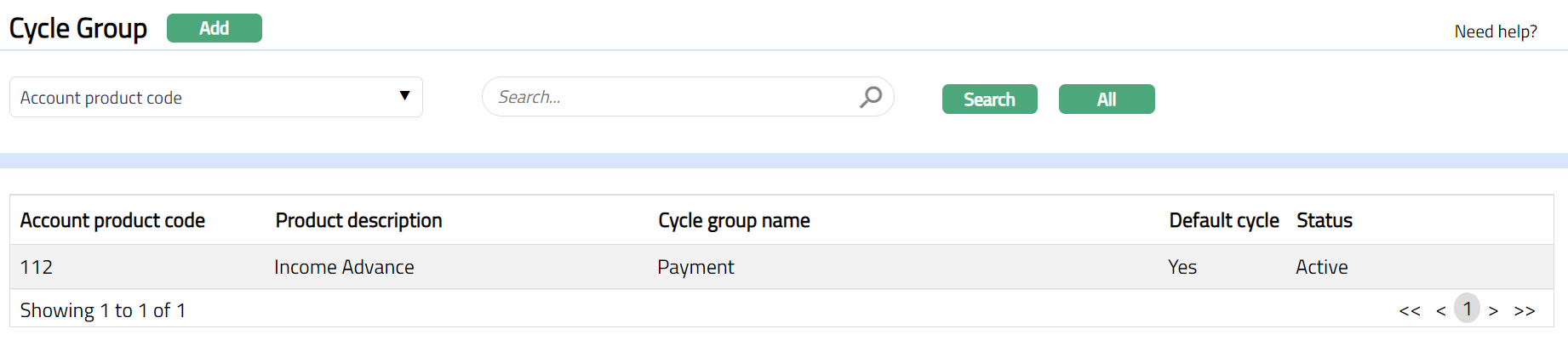
  2. Click Add. New Cycle Group - (1/2) page appears.
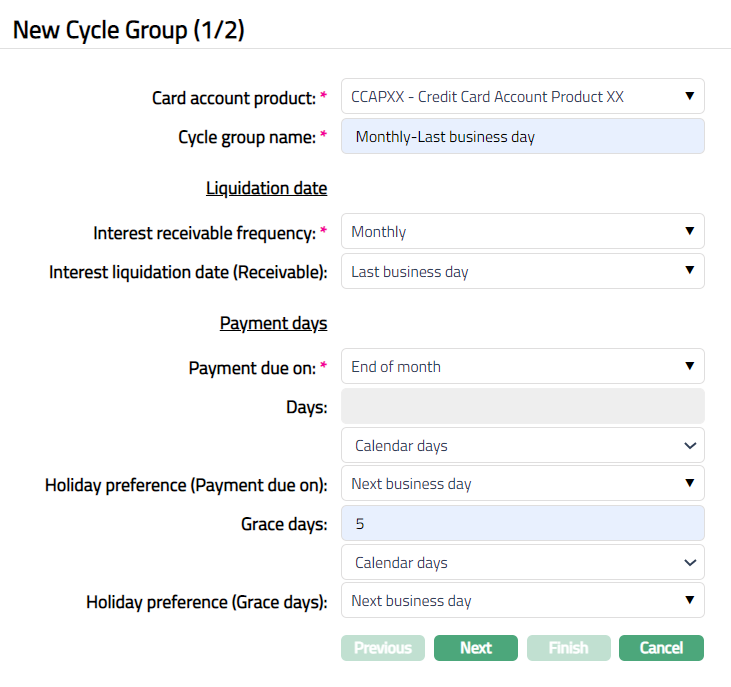
  3. Select Card account product for the new cycle group from the drop-down list. The list will display all the active Card Account Products maintained at Card > Settings > Card Account Product.

  4. Enter name for Cycle group.

  5. Select Interest receivable frequency for the Interest Receivable accrual from the drop-down list. Available options are: Monthly, Quarterly, Semi-annual and Annual.

  6. Specify when the Interest receivable has to be liquidated (capitalized) in the Interest Liquidation date (Receivable). It is the date on which the interest will be posted to the accounts under this product. Available options are as follows:

  • Day: If you want the interest to be liquidated on a specific date of the calendar month, choose this option. You need to then specify the day in the Day field.

  • Last Calendar Day: If you want the interest to be liquidated on the last calendar day of the selected frequency instead of the specified date, choose this option.

  • Last Business Day: If you want the interest to be liquidated on the last business day, then choose this option.

  • X days before last calendar day: If you want the interest to be liquidated x days before the last calendar day, then choose this option.

  • X days before last business day: If you want the interest to be liquidated x days before the last business day, then choose the option.

Note:

  • If frequency is Monthly

    • If 31 is chosen and if the month has 30 days interest will be liquidated on 30th of the month

    • If 30 is chosen and if the month has 31 days interest will be liquidated on 30th of the month

  • If frequency is quarterly, semi-annual or annual, the 'Day' parameter is interpreted in the same way as month; however, the month will be

    • March, June, September and December -- if it is quarterly,

    • June and December -- if it is semi-annual

    • December -- if it is annual

      If Interest liquidation date is selected as X days before last calendar day or X days before last business day, you need to then specify the value for the X in the Number of days field and also indicate if these days are calendar days or business days. The number of days field is available twice so that you can specify the interest liquidation date as: 5 business days before 2 calendar days before last calendar day

      If interest liquidation date so arrived at is a holiday, specify how it should be treated using the Holiday preference. The options are:

    • Ignore: If this option is chosen, then the holiday will be ignored, and interest will be liquidated on same day. This is the default option selected.

    • Next business day: If this option is chosen, then interest will be liquidated on the next business day.

    • Previous business day: If this option is chosen, then interest will be liquidated on previous business day

  1. Select option for when the Payment is due using the Payment due on.

The following table shows how the Payment due on is arrived at for each of the options. In this table, the Start date and End date for the cycle is taken as 26-Apr-2013 and 25-May-2013 respectively and X days is taken as 5 days.

Payment Due Dates

SlOption ChosenPayment due on
1End of cycle25-May-2013
2End of month31-May-2013
3Last business day of month31-May-2013
4Next end of cycle25-Jun-2013
5Next end of month30-Jun-2013 -- but, since this is beyond Next End of Cycle (i.e. 25-Jun-2013), Payment due on will be 25-Jun-2013
6Last business day of next month28-Jun-2013 -- but, since this is beyond Next End of Cycle (i.e. 25-Jun-2013), Payment due on will be 25-Jun-2013
7X days after End of Cycle30-May-2013
8X days after End of Month5-Jun-2013
9X days before next End of Cycle20-Jun-2013
10X days before next End of Month25-Jun-2013
11X days after next End of Month5-Jul-2013 -- but, since this is beyond Next End of Cycle (i.e. 25-Jun-2013), Payment due on will be 25-Jun-2013

If option 11 is chosen above, Interest receivable Liquidation frequency options Daily and Monthly will be disabled.

Note: During every Invoice generation, if Payment due date is greater than next EOC, Payment due date will be taken as the next EOC. Similarly, if during invoice generation, if Payment due date falls within the same cycle, Payment due date will be taken as the current EOC date. This will be the case even if the Fix Payment Date at account level is marked Yes.

Also, the actual Payment Due Date will be in conjunction with the Invoice generation date (i.e., the Debit Interest liquidation date). For example, if the Frequency is quarterly and the Payment due on is Last business day of month, the payment due date for the invoice generated during March 2013 will be 29th Mar 2013, assuming 30th and 31st Mar are holidays.

  1. If you have selected options 7 to 11 above, you need to specify the number of Days to be taken for the Payment due date calculation and also indicate if the number days should be taken as calendar days or business days.

    • Indicate Holiday Preference (Payment due on) for the Payment due date calculated using the above values.

Following options are available:

  • Ignore: If the Payment due date falls on a holiday, and you still want to retain that date as the payment due date, choose Ignore. For Example, if the Payment due date is 25^th^ Dec which is a holiday and you have chosen Ignore, the payment due date will still remain 25^th^ Dec.

  • Next Business Day: If the Payment due date falls on a holiday, and you want to move it to the next business day, choose this option. In our above example, if this option is chosen, the Payment due date would be 26^th^ Dec.

  • Previous Business Day: If the Payment due date falls on a holiday, and you want to move it to the previous business day, choose this option. In our above example, if this option is chosen, the Payment due date would be 24^th^ Dec.

  1. Grace days enables you to provide a few additional days for the customer to make his payment; and if the customer makes the payment by the end of the Grace days period, the payment is considered as having been received by the Payment due date. Enter the required number of Grace days and indicate if these days should be calendar days / business days.

Note: If payment is made within the grace days, even if it is after the payment due date, the payment is not treated as overdue and associated charges / interest is not applied. If payment is not received within the payment date + grace days, then overdue interest accrual starts from the payment due date onwards.

  1. Indicate Holiday preference (Grace days) for end of grace days calculated using the above values. If Grace days is business days, then this field will be disabled. In case of calendar days, indicate if the end of grace days arrived at is a holiday, whether it should not be moved / moved to next / previous working day.

  2. Click Next. New Cycle Group -- Confirmation (2/2) page appears.
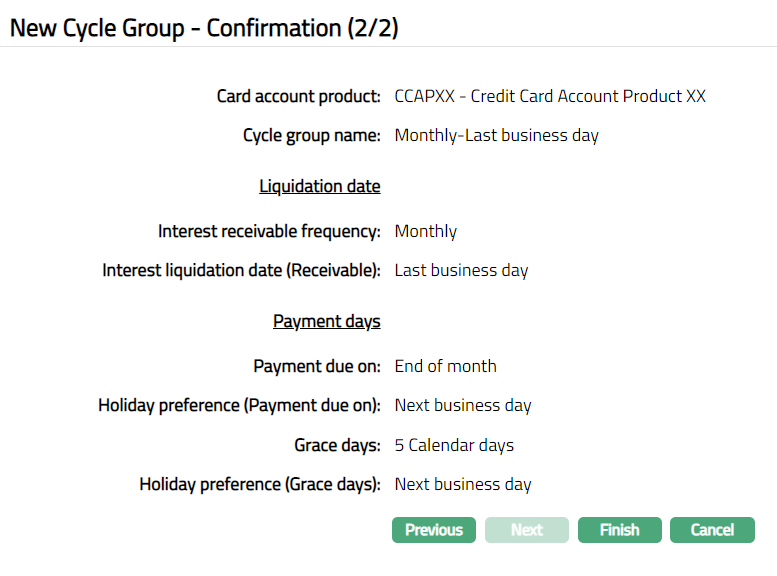
  1. Click Finish. Cycle Group page appears with the added details.
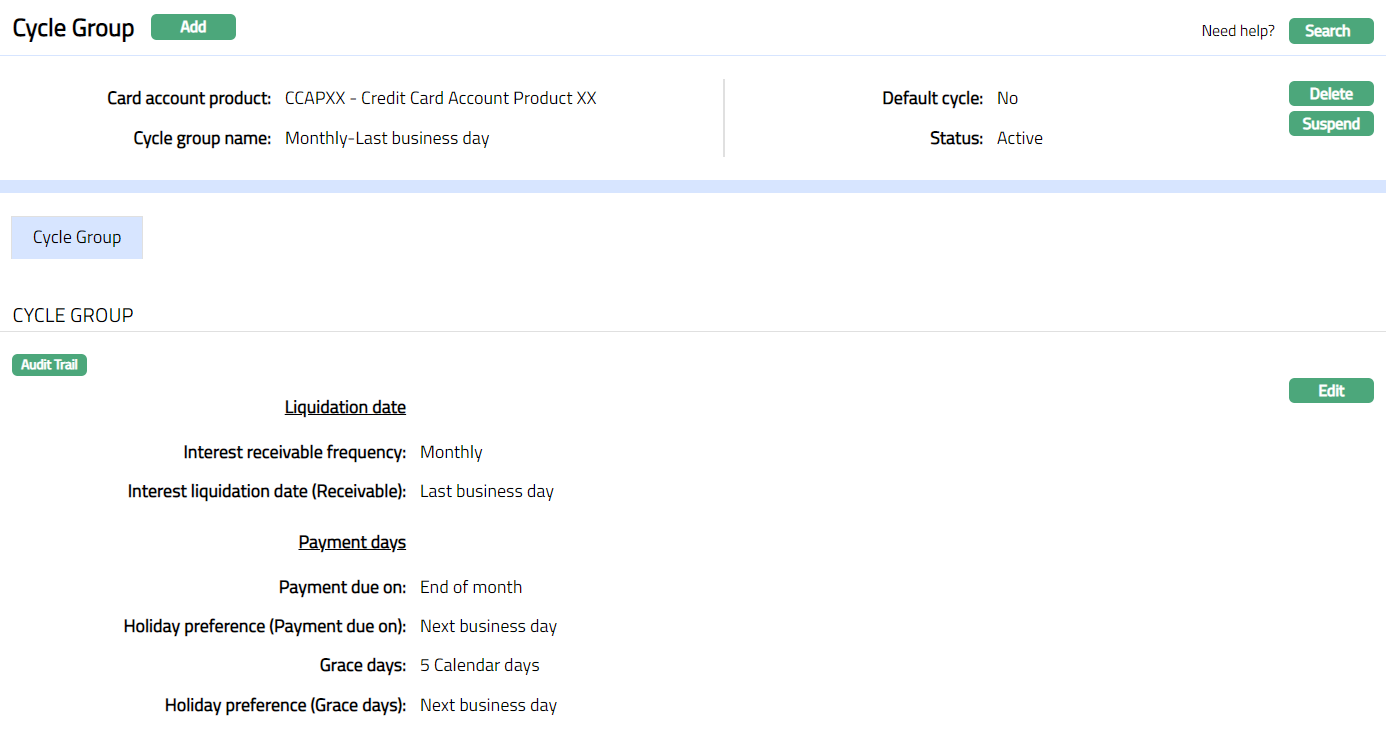
    Functions: Add, Search, Delete, Suspend, Activate

    The additional fields available are:

    If the Cycle group is Default cycle for any product, then Yes will be displayed for this field else No will be displayed.

Note: Edit, Delete and Suspend buttons will be disabled for the Default Cycle Group but will be allowed for non-default Cycle Groups.

Cycle Group

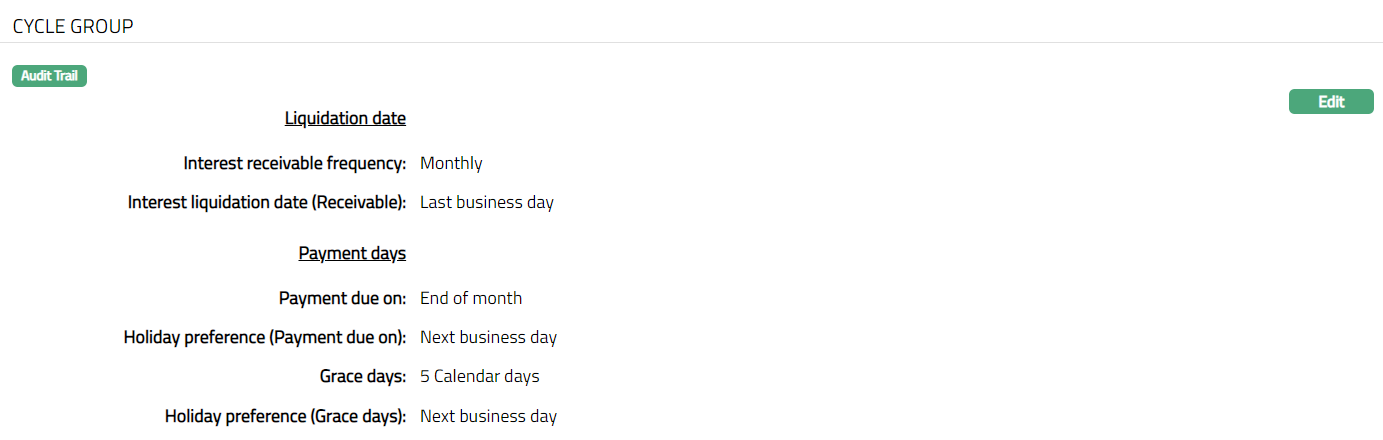
This tab will allow you view and edit the Cycle group. Default Cycle group cannot be edited under this tab.

To edit Cycle Group

  1. Access Cycle Group page.

  1. Click Edit. Edit Cycle Group page appears.
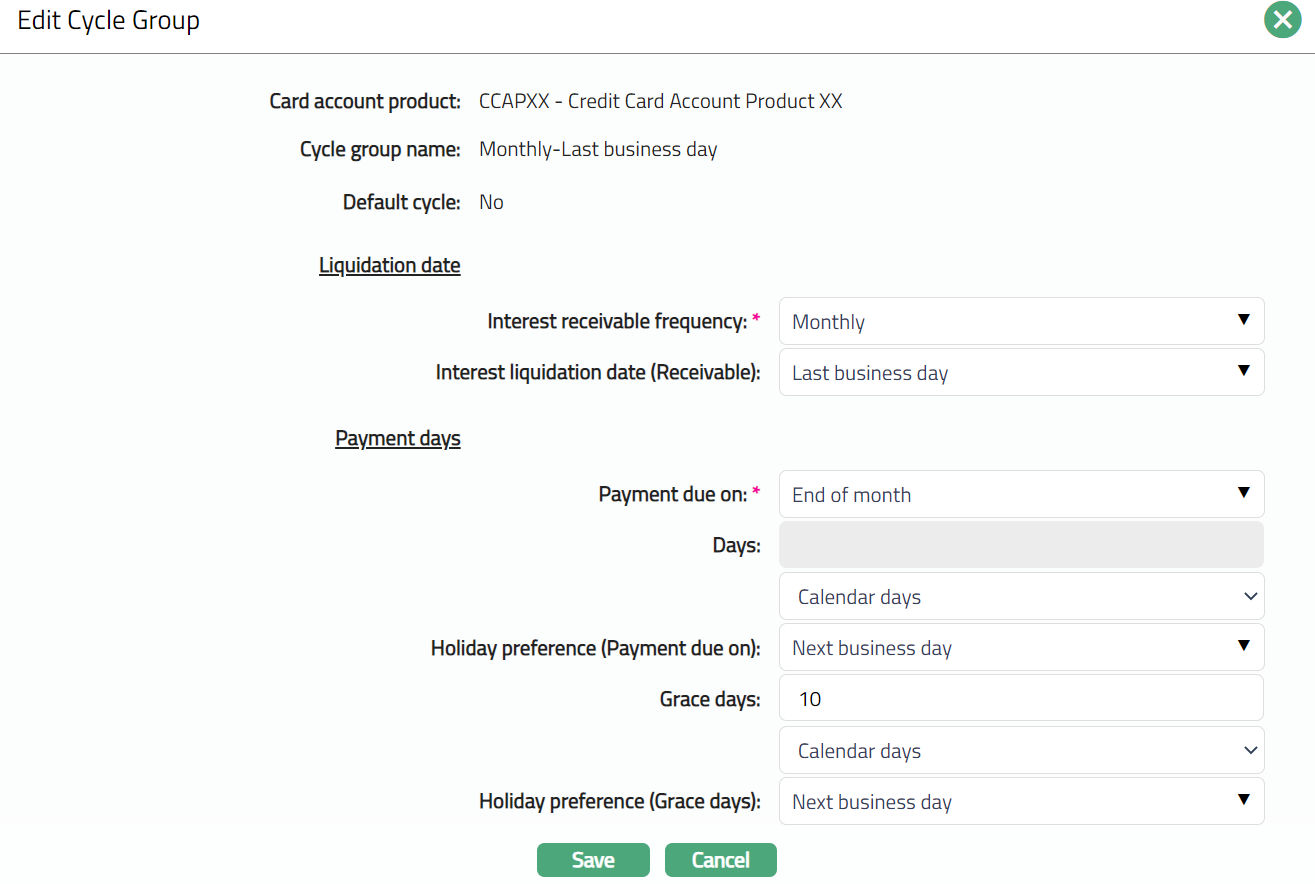
Note: Except Card account product, Cycle group name and Default cycle fields rest all other fields are editable.

  1. Click Save. Cycle Group Page appears with the edited details.
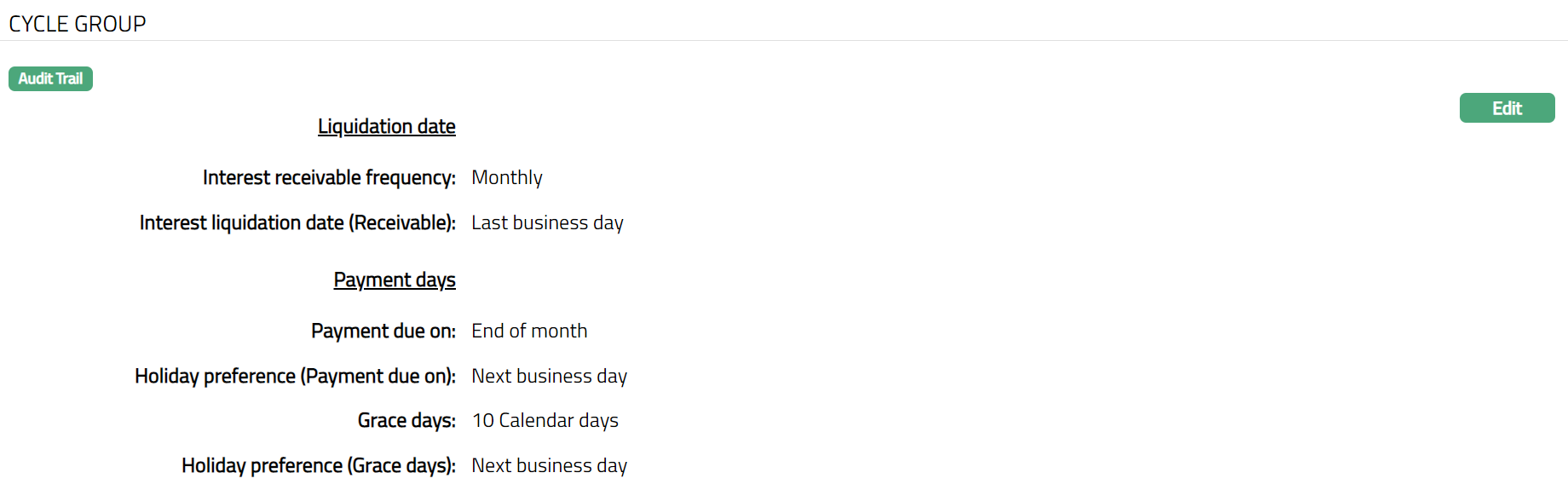
Function: Edit

Prev
Charge group
Next
Interest group