
Charge Rule
Charge Rule functionality allows you to add any rule/ trigger for the charge. Each trigger will have conditions, joined by an operator. CC-PG will provide rule to fetch the charge scheme maintained in any Core Bank system. If the rule is satisfied, then the charge scheme will be attached to the charge and imposed on Incoming or Outgoing payments. If the condition is not satisfied or the charge scheme attached to the charge rule is not maintained, then CC-PG will impose nil charges on the Incoming or Outgoing payments. The rules will be applied in the order of preference that you set up under the Rule Sequence. There are two sub-tabs which will allow you to maintain the Charge Rule and the Sequence.
The two sub-tabs are:
To add Charge rule
- From PaymentGrid menu, click Settings and click Charge rule. Charge Rule Search page appears.

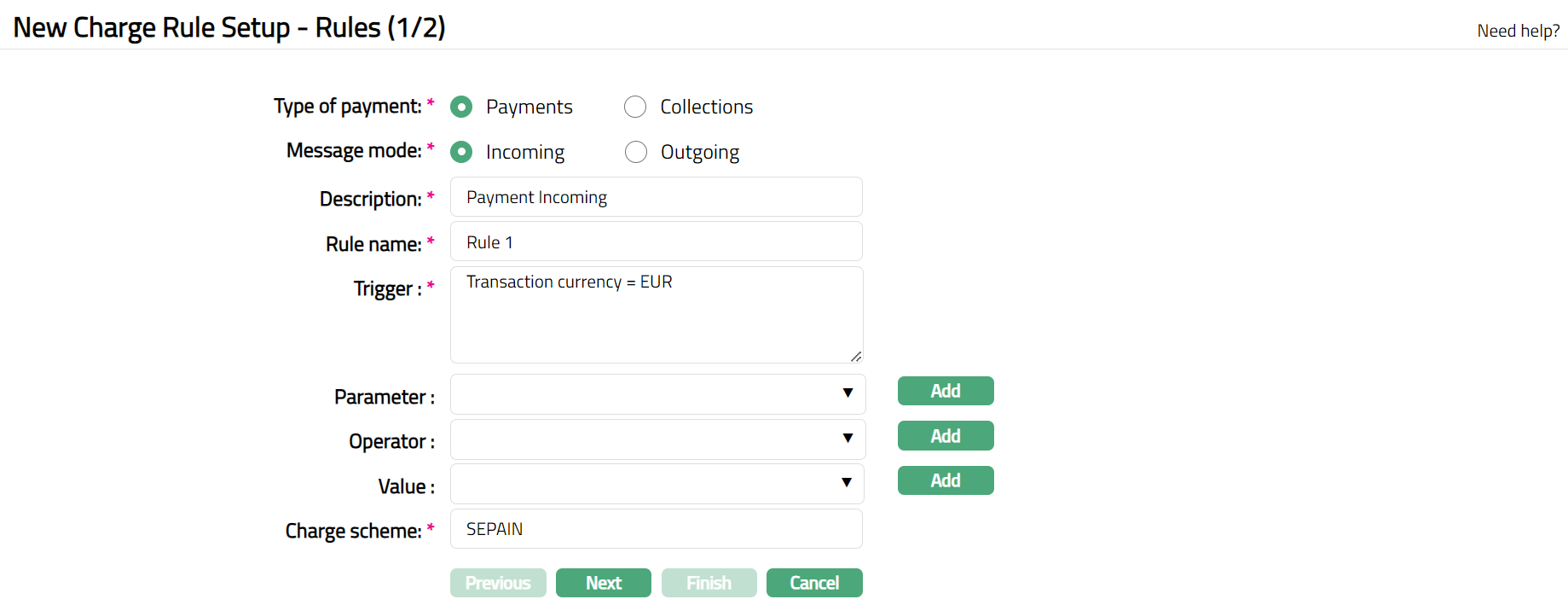
- Click Add. New Charge Rule Setup -- Rules (1/2) page appears.
Payments- Incoming
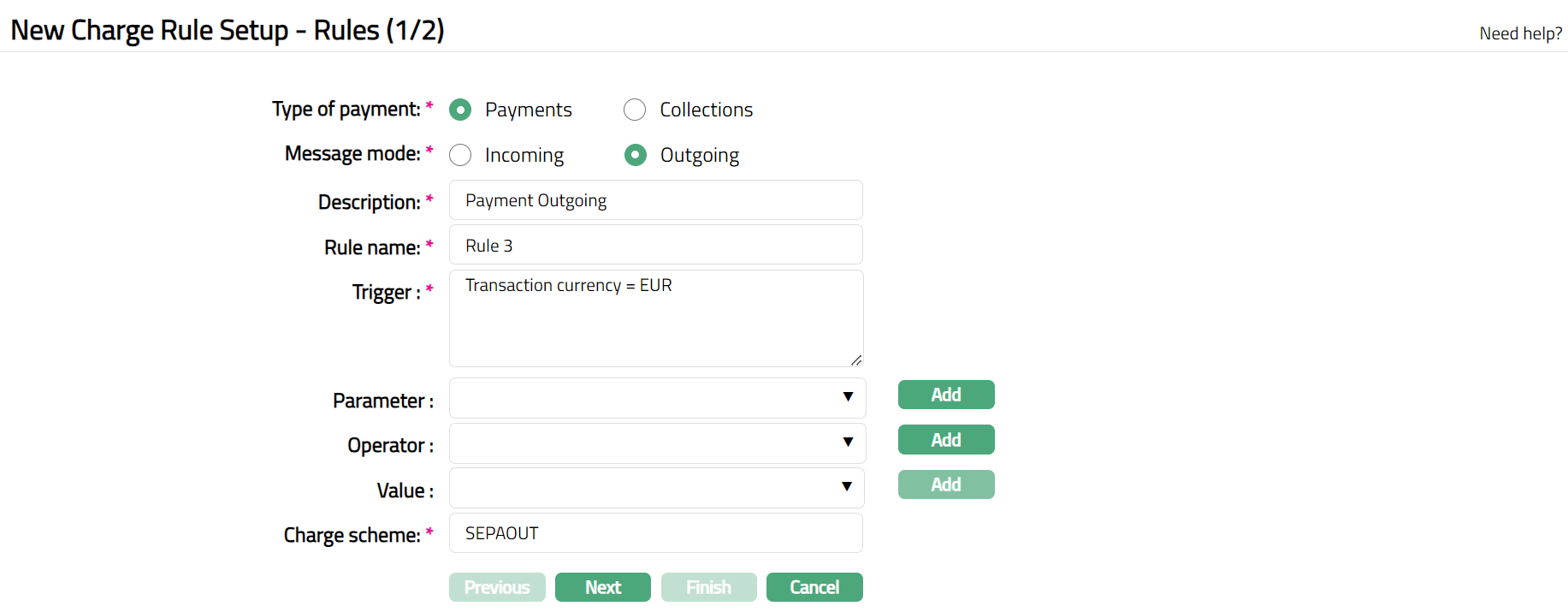
Payments - Outgoing
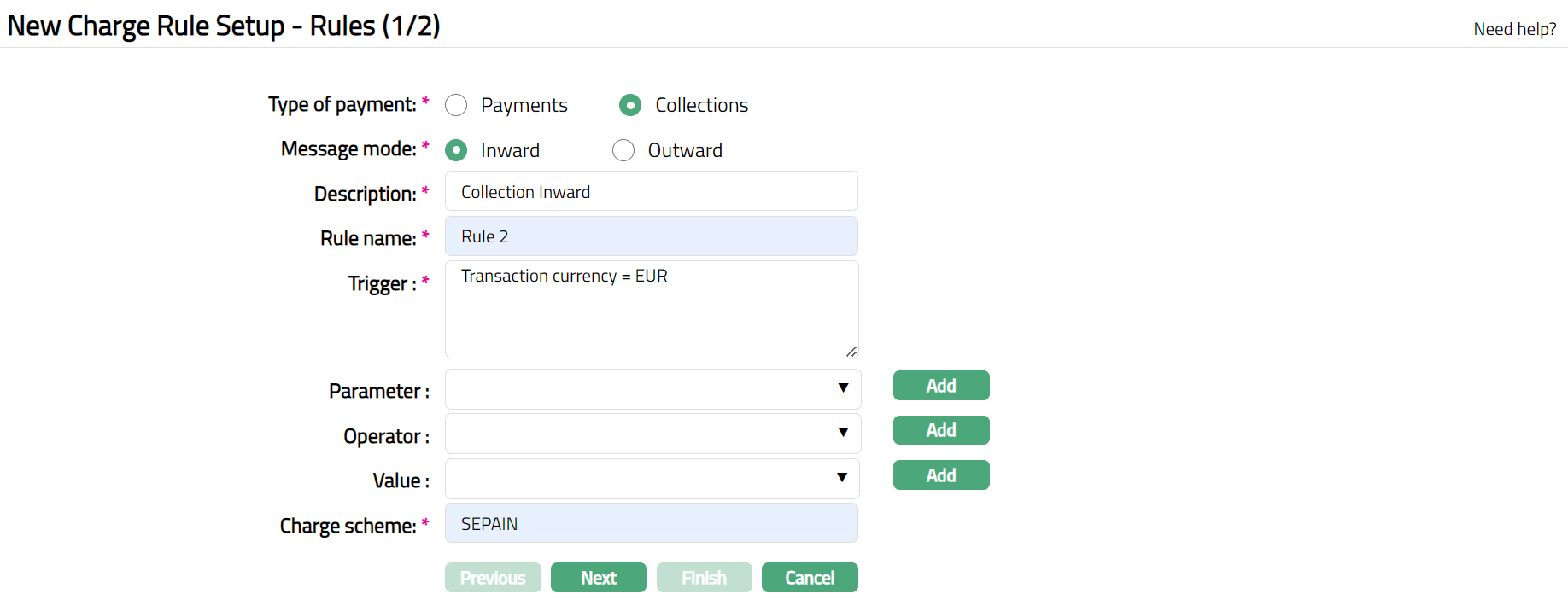
Collections -- Inward
Collections -- Outward
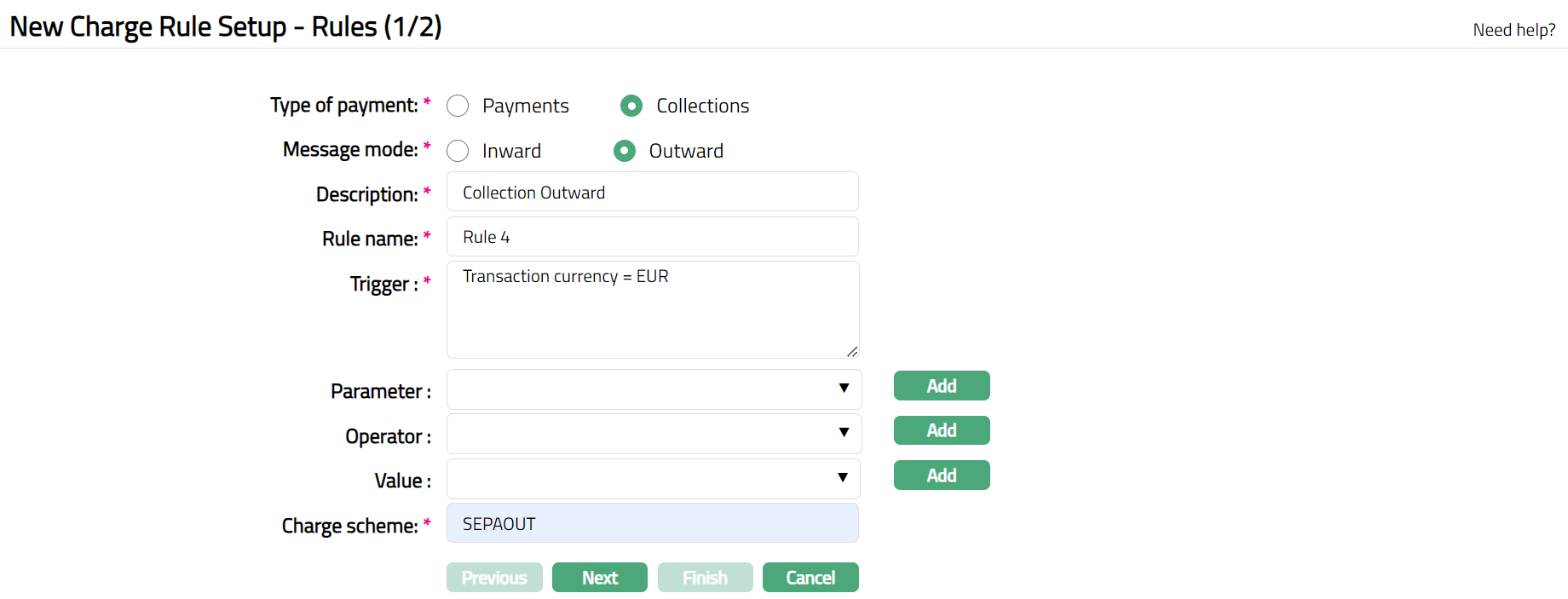
Select Message mode. Mode can be Incoming or Outgoing. By default, Incoming will be selected.
Enter Description for the Charge Rule setup.
Enter Rule name. It is the name of the rule for the charge.
Enter Trigger details. Each trigger will constitute a collection of individual conditions joined by an Operator. Trigger details can be built using the Parameter, Operator and Value.
Select Parameter from the pre-shipped list and click Add. CC-PG will push the selected value of Parameter into the Trigger text area above. Based on the Parameter selected, the Operator and Values will change. See detailed explanation below.
Select Operator from the pre-shipped list and click **Add. **CC-PG will push the selected value of Operator into Trigger text area above. See detailed explanation below.
Enter required Values for the Parameter and click Add. CC-PG will push the selected value into Trigger text area above. See detailed explanation below.
Details of the Parameter, Operator and ValuesAccount with institution: It specifies the financial institution which provides services for the beneficiary client's account. If this parameter is chosen, enter the BIC code in the Value field. Charge is picked, if the condition satisfies.
Action: If this parameter is chosen, the Value field shows the following list of options
Book: You can choose this option if you want to apply charges when a transaction is booked. If the action is taken and the condition is satisfied, the charge is applied for the action taken.
Enrich: You can choose this option if you want to apply charges when there is exchange of information between the Core Bank and CC-PG. If the action is taken and the condition is satisfied, the charge is applied for the action taken.
Create: You can choose this option if you want to apply charges when a transaction is created (i.e., when the accounting entries for debit / credit processing are passed). If the action is taken and the condition is satisfied, the charge is applied for the action taken.
Payout: You can choose this option if you want to apply charges when a Payout is required. If the action is taken and the condition is satisfied, the charge is applied for the action taken.
Cancel: You can choose this option if you want to apply charges when a transaction is cancelled. If the action is taken and the condition is satisfied, the charge is applied for the action taken.
Reverse: You can choose this option if you want to apply charges when a transaction is reversed. If the action is taken and the condition is satisfied, the charge is applied for the action taken.
Delete: You can choose this option if you want to apply charges when a transaction is deleted. If the action is taken and the condition is satisfied, the charge is applied for the action taken.
Reject: You can choose this option if you want to apply charges when a transaction is rejected. If the action is taken and the condition is satisfied, the charge is applied for the action taken.
Recall: You can choose this option if you want to apply charges when a transaction is recalled. If the action is taken and the condition is satisfied, the charge is applied for the action taken.
Bank Operation Code: If this parameter is chosen, enter the Bank Operation Code in the Value field. For example: 23B: SPAY. : 23B is the tag for the Bank Operation Code and SPAY is the code. You can give a trigger as Bank Operation Code = SPAY. If condition satisfies, charge is applied.
Beneficiary Client: If this parameter is chosen, enter the client's name in the Value field.
Beneficiary Country: If this parameter is chosen, enter the active country name in the Value field.
Beneficiary institution: If this parameter is chosen, enter the Beneficiary institution BIC in the Value field.
Charge account: If this parameter is chosen, enter the account number in the Value field.
Charge bearer: If this parameter is chosen, enter the codes in the value field based on the clearing network, as per examples given below:
Clearing Network Values SWIFT/TARGET2 SHA/BEN/OUR SEPA DEBT/CRED/SHAR/SLEV
Clearing network: If this parameter is chosen, select the option for Clearing network from the drop-down list in the Value field. The pre-shipped options are, SEPA, TARGET2, BANKGIRO, SWIFT, and PLUSGIRO.
Clearing number: If this parameter is chosen, enter the clearing number in the Value field. For example, Autogiro network, the standard number is 9900. Each bank will have their respective clearing number.
Credit account: If this parameter is chosen, enter the credit account number of the client in the Value field.
Creditor BIC: If this parameter is chosen, enter the Creditor's BIC number in the Value field.
Creditor Giro number: If you choose this parameter, enter the Creditor Giro number in the value field.
Creditor reference: If you choose this parameter, enter the reference number of the creditor in the Value field.
Debit account: If this parameter is chosen, enter the Debit account number in the value field.
Debtor BIC: If this parameter is chosen, enter the Debtor's BIC number in the value field.
Debtor Giro number: If you choose this parameter, enter the Debtor Giro number in the value field.
External source: If you choose this parameter, then specify the external source in the Value field. For example: for PaymentGrid, CC-PG is the external source.
Instructed amount: The amount specified here is for instruction. It is the amount which is same as specified in the message. If you choose this parameter, enter the instructed amount in the Value field.
Instructed currency: It is the currency of the Instructed amount. If you choose this parameter, then select the currency in the Value field, from the drop-down list of currencies maintained under Admin > System codes > Currencies > Currencies.
Intermediary institution: It is the financial institution through which the transaction passes to reach the Account with Institution. If you choose this parameter, then enter the BIC code of the Intermediary institution in the Value field.
Message Priority: If you choose this parameter, select the option for the Message Priority from the drop-down list in the Value field. The available options are System, Normal, and Urgent.
Ordering customer: It is the customer who orders the transaction. If this parameter is chosen, enter the ordering customer's name in the Value field.
Ordering institution: It is the financial institution of the ordering customer. If this parameter is chosen, enter the BIC code of the Ordering Institution in the Value field.
Pay by cash: If a customer, who does not have an account with the bank, walks in for a transaction, you can apply a charge on that transaction by using this option. If this option is chosen as a parameter, then select Yes or No option from the drop-down list in the value field.
Receiver charges amount: It is the amount of transaction charges payable by the receiver. If this option is chosen as a parameter, enter the amount in the Value field.
Receiver charges currency: It is the currency of transaction charges amount payable by the receiver. If you choose this parameter, then select the currency in the Value field, from the drop-down list of currencies maintained under Admin > System codes > Currencies > Currencies.
Receivers' correspondent: It is the branch of the receiver or another financial institution at which the funds will be made available to the receiver. If this option is chosen as a parameter, enter the BIC code of the Receiver correspondent in the Value field.
Remittance information: It specifies the details of the individual transaction or a reference to another message containing the details which are to be transmitted to the beneficiary customer. If this option is chosen as a parameter, enter the code (like INV, IPI, RFB) in the Value field.
Sender to receiver info: It specifies additional information for the Receiver or other party specified. If this option is chosen as a parameter, enter the code (like ACC, INS, INT) in the Value field.
Sender's charges amount: It specifies the amount of the transaction charges deducted by the Sender and by previous banks in the transaction chain. If this option is chosen as a parameter, enter the Senders charge amount in the value field.
Sender's charges currency: It is the currency of transaction charges deducted by the Sender and by previous banks in the transaction chain. If you choose this parameter, then select the currency in the Value field, from the drop-down list of currencies maintained under Admin > System codes > Currencies > Currencies.
Sender's correspondent: When two financial institutions do not have direct relationship and communicate via correspondent, then the financial institution associated with sender is the Sender's Correspondent. If this option is chosen as a parameter, enter the BIC code of the Senders correspondent in the Value field.
Sender's reference: It specifies the reference assigned by the Sender to unambiguously identify the message. If this option is chosen as a parameter, enter the reference number in the Value field.
Sending institution: It identifies the Sender of the message. If this option is chosen as a parameter, enter the Sending institution BIC code in the Value field.
Service identifier: It specifies the character values of SWIFT/TARGET2 network. If this option is chosen as a parameter, enter the code for the service identifier in the value field. For example: 01, 03, 021 (as mentioned in Block 1)
Service delivery channel: It is the mode/medium through which the customers interact with the financial institutions and by which the financial institution delivers its products and services to the customers. If you choose this parameter, then select the Service delivery channel in the Value field, from the drop-down list of options maintained under Admin > System codes > Categories > Service delivery channel
TAG 119: If this parameter is chosen and the condition satisfies, then product attached to the TAG 119, will be picked and Charge is applicable. For example:
If TAG 119 = COV, then it is a Cover message
If TAG 119 = TGT, then it is a TARGET2 message.Third reimbursement institution: It specifies the Receiver's branch, when the funds are made available to this branch through a financial institution other than that indicated in field 53a. If this option is chosen as a parameter, then enter the BIC code of the institution in the Value field.
Transaction amount: It specifies the amount of the subsequent transfer to be executed by the receiver. If this option is chosen as a parameter, then enter the amount in the Value field.
Transaction code: It specifies the nature of, purpose of, and/or reason for the individual transaction. For example, salaries, pensions, dividends. If this option is chosen as a parameter, then enter the code in the Value field. For example: 26T:K90
Transaction currency: It specifies the currency of the Transaction Amount. If you choose this parameter, then select the currency in the Value field, from the drop-down list of currencies maintained under Admin > System codes > Currencies > Currencies.
Transaction date: It specifies the date of the transaction. If this parameter is chosen, then enter the date in the Value field.
Transaction reference: It specifies the reference number that is generated by CC-PG for the individual transaction. If this option is chosen as a parameter, then enter the reference number in the Value field.
Transfer type: It specifies the type of transfer, whether the transfer is made to the bank or to the customer. If this parameter is chosen, select the option for Transfer type from the drop-down list in the Value field. The pre-shipped options are Customer and Bank.
Value date: It specifies the value date of the transaction. If this parameter is chosen, then enter the value date in the Value field.
Enter Charge scheme maintained in external system, which should be used to calculate the charges if this rule is satisfied. Based on the rule defined, the charge scheme is picked.
Click Next. New Charge Rule -- Confirmation (2/2) page appears.
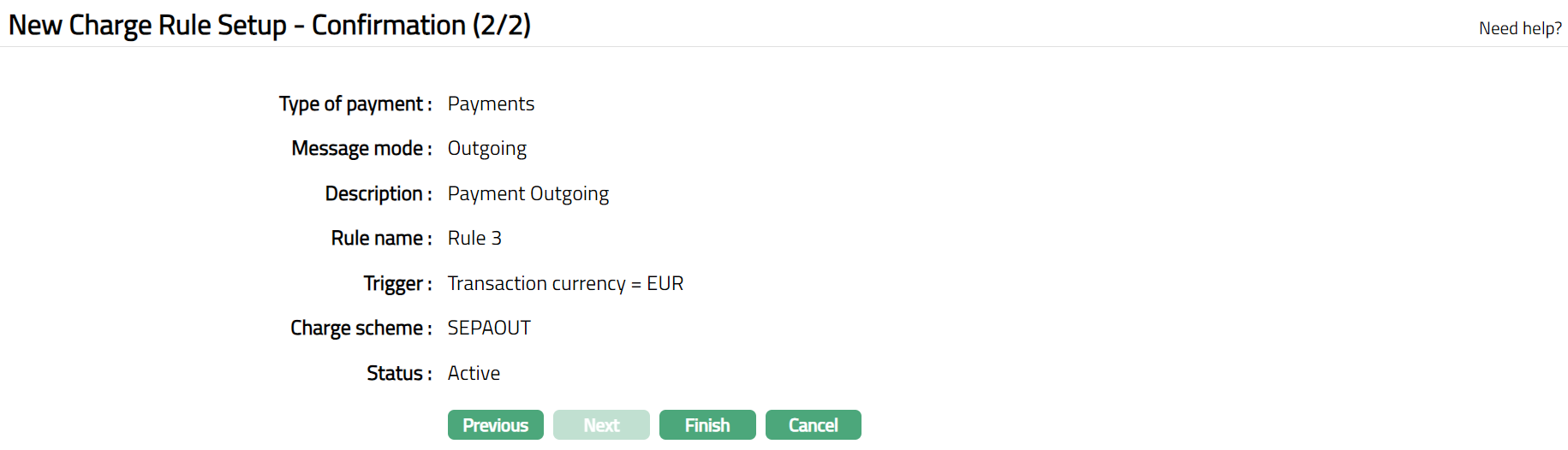
- Click Finish. Charge Rule page appears. New Charge Rule is created, and you can see the Rules tab by default.
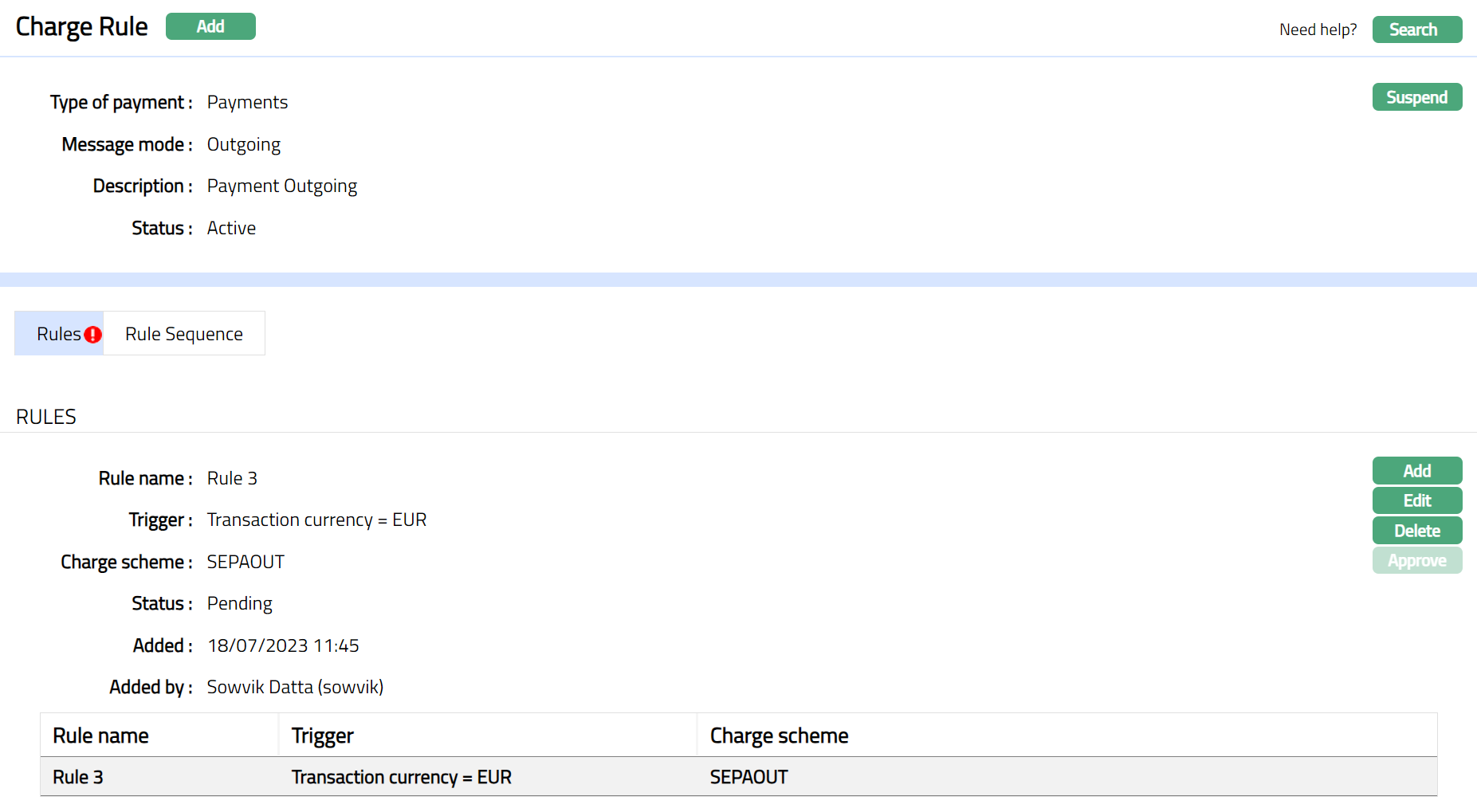
Functions: Add, Search, Suspend, Activate
Note: On creation of a new Charge rule, the Status by default will be Active, the record status will be Pending, and a blue bubble appears on the Rules tab. Only on Approval, the record Status gets changed to Approved and the blue bubble disappears.
Delete: You can delete a Charge Rule by clicking on Delete button. When you click on Delete button, CC-PG will ask for confirmation on deletion. CC-PG will delete the Charge Rule. However, you cannot delete a Charge Rule when any product is using this Charge Rule.
Approve: If you want to approve a Charge rule, then retrieve the record and click on Approve. CC-PG will ask for confirmation. Once the tab is approved, status gets changed from Pending to Approved.
Suspend: You can suspend the charge by clicking on Suspend button. When you click on Suspend button, CC-PG displays an alert message. On confirmation CC-PG will suspend the Charge rule. Once the charge is suspended, the rule will not be applicable while processing a message. Suspended charges can be activated by using Activate button.
Activate: You can activate a suspended charge by clicking on Activate button. When you click on Activate button, CC-PG displays an alert message. On confirmation CC-PG will activate the Charge rule. Once the charge rule is activated, it becomes available for processing.
Rules
Rule tab which is the default tab in the Charge Rule screen, shows the basic details of the rule set up for the charge. You can add new charge rules and maintain the added charge rules.
To view / add / edit charge rule.
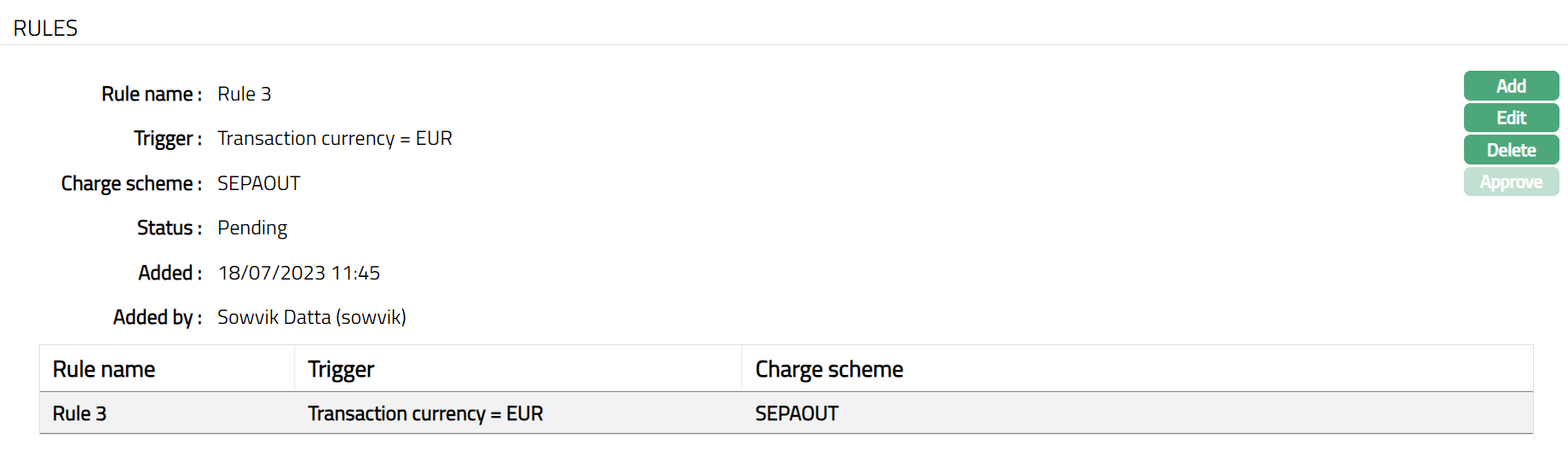
- Access Charge Rule page and click Rules tab to view the details as per sample below. The details are defaulted from the entries that you made during New Charge Rule Setup. For details refer to New Charge Rule Setup -- Rules (1/2) page.
- Click Add. Add Rule page appears.
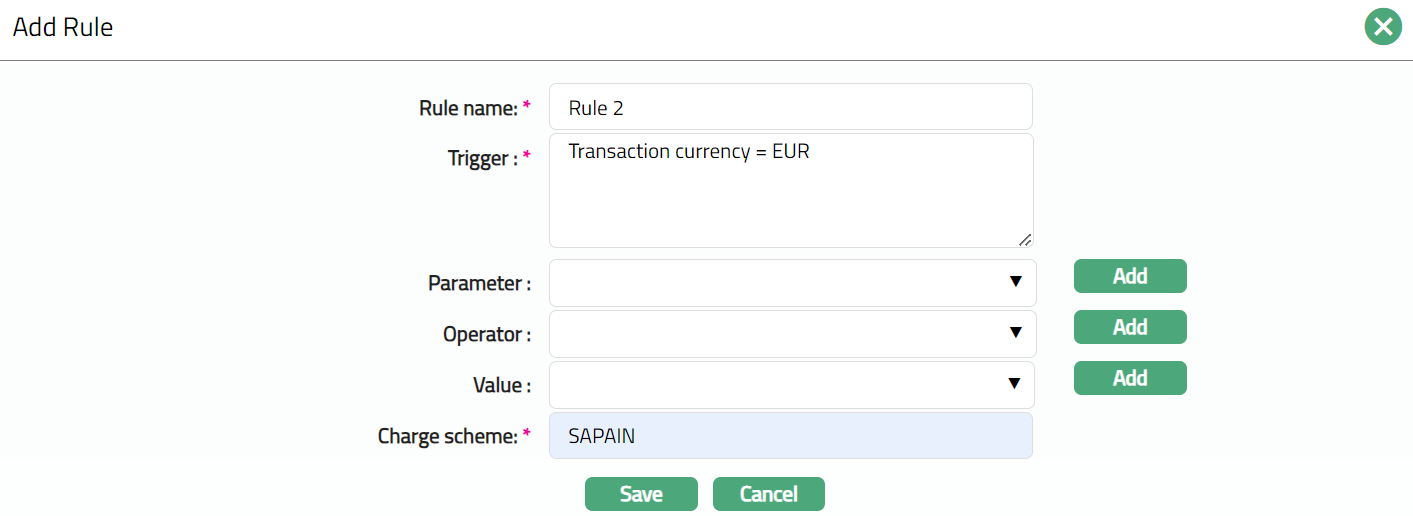
The value for Message mode is defaulted from Message mode selected in New Charge Rule Setup -- Rules (1/2) screen. For the details regarding the fields, please refer to New Charge Rule Setup -- Rules (1/2) screen.
Click Save. Rule tab appears with the added details.
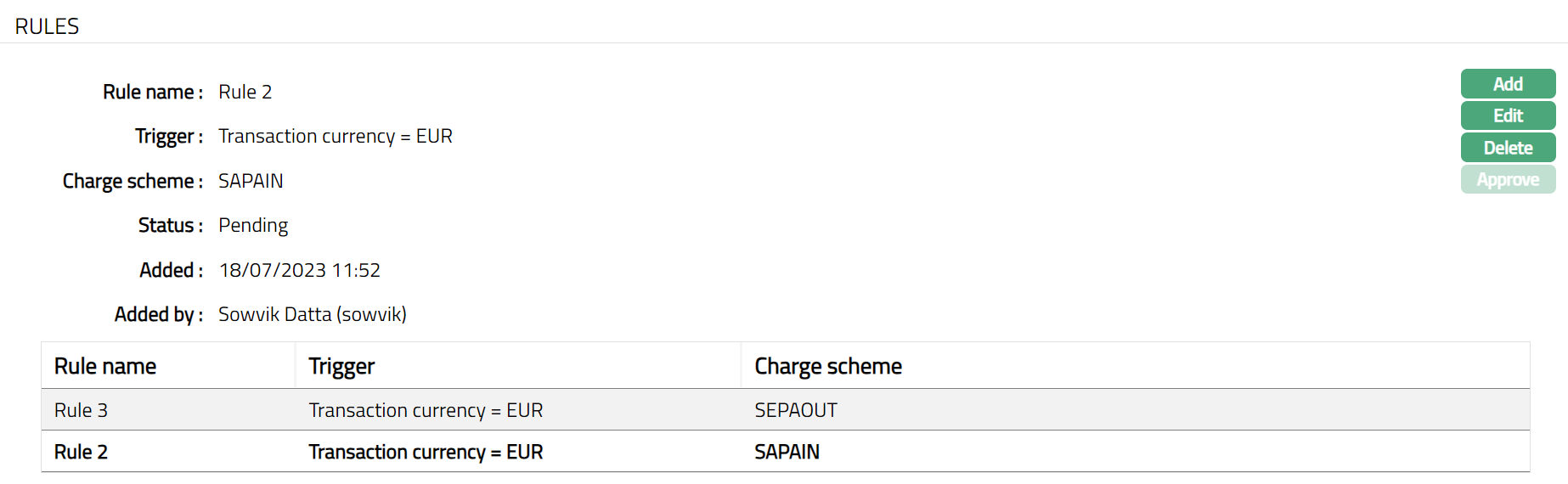
Functions: Add, Edit Delete, Approve
Note: Once added/ edited, the Status of the tab will be Pending, and Red bubble appears on the Rules tab. Only on Approval, the Status gets changed to Approved and the Red bubble disappears.
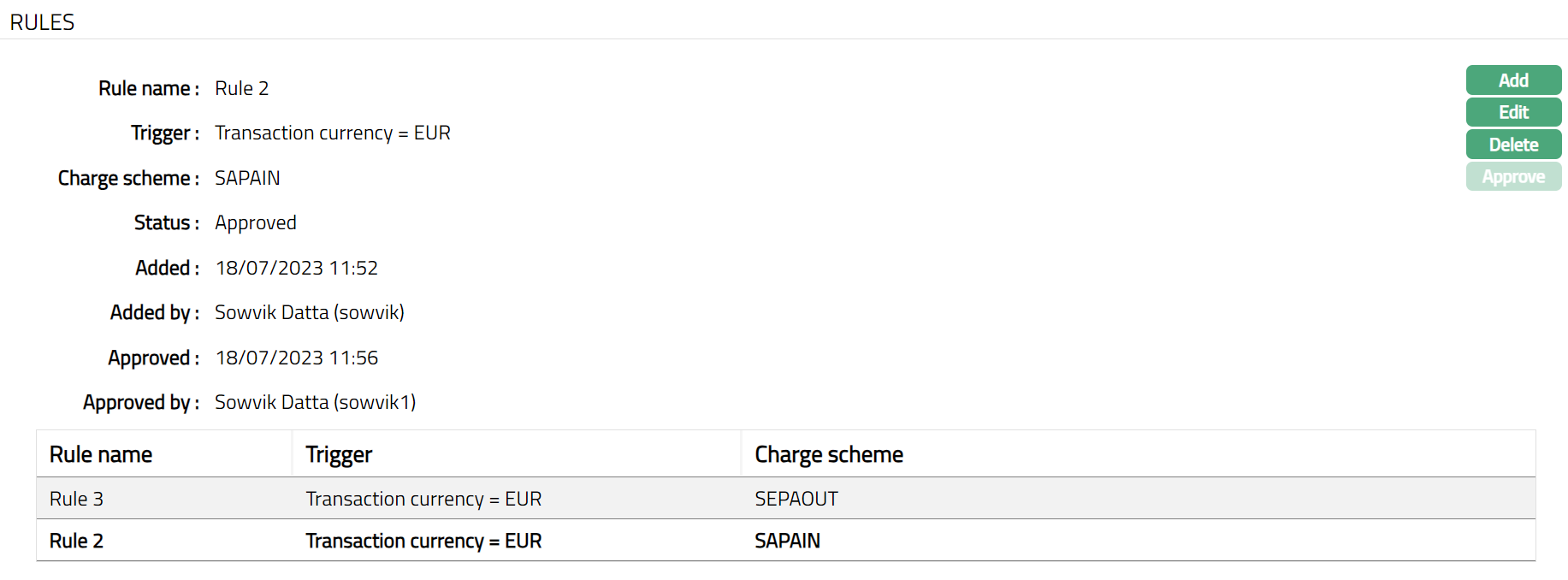
Functions: Add, Edit Delete, Approve
The additional fields that you can view in the Rules tab are as follows:
Status field denotes the status of the tab.
Added field denotes the date on which the record was added.
Added by field denotes the name of the user who created the record.
Approved field denotes date on which the record was approved and is displayed only for approved records.
Approved by field denotes name of the user who approved the record and is displayed only for approved records.
To edit Rules
- Click Edit. Edit Rules page appears.
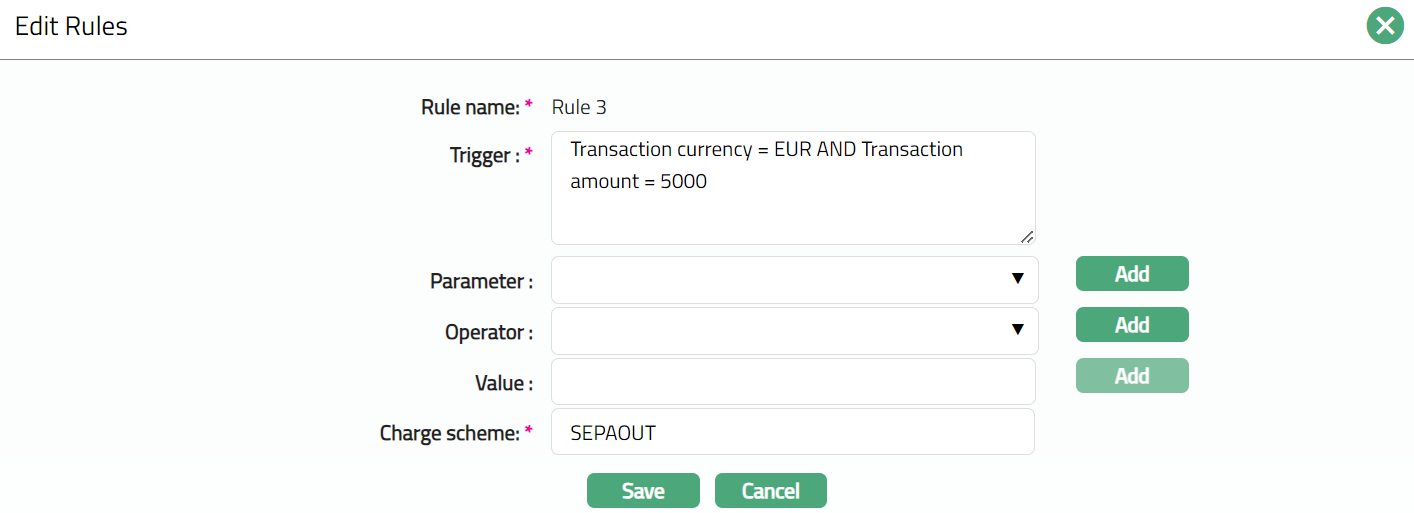
Note: Except Rule name field, rest all other fields are editable.
- Click Save. Rules tab appears with the edited details. The Status of the tab will be Pending, and Red bubble appears on the Rules tab. Only on Approval, the Status gets changed to Approved and the Red bubble disappears.
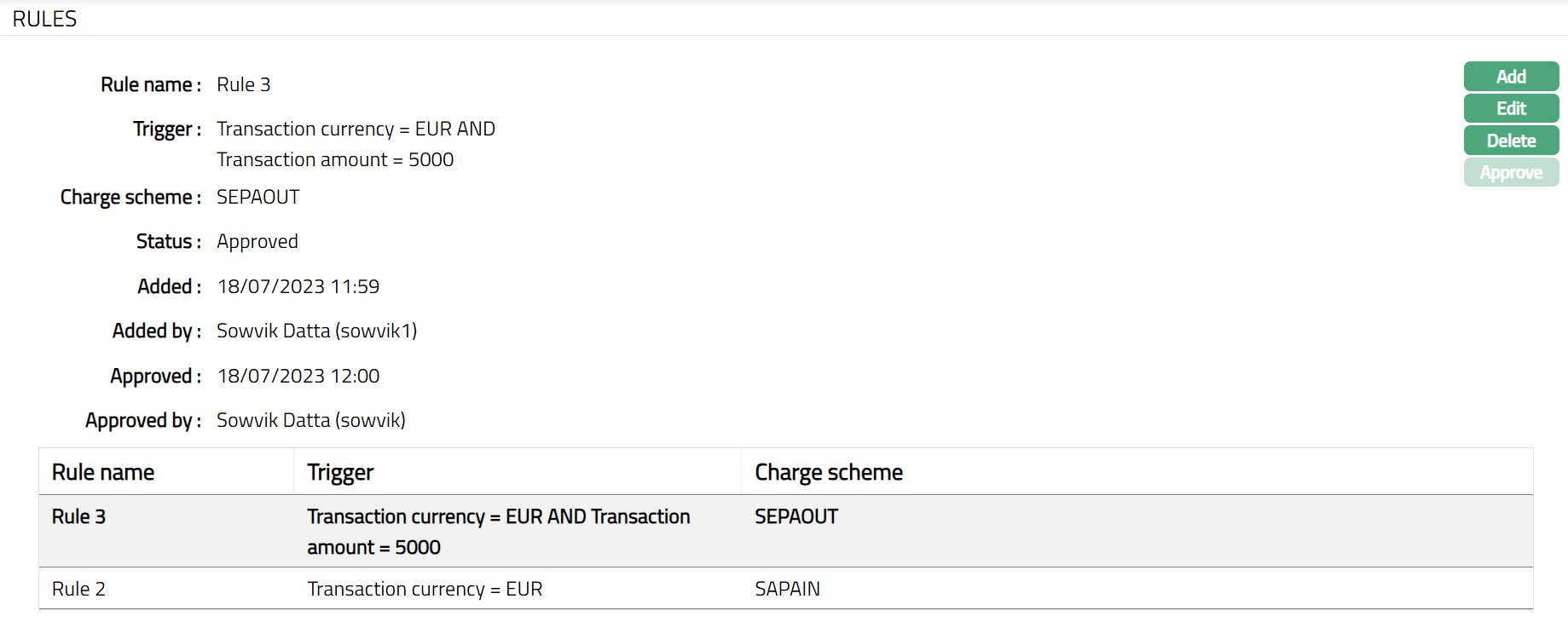
Functions: Add, Edit Delete, Approve
Rule Sequence
You can define the order in which the rules have to be executed using the Rule Sequence tab. By default, it will contain all the maintained Rule names. It will be displayed in ascending order and will have the provision to manipulate the sequence, as you require.
To define Rule Sequence,
- Access Charge Rule page and click Rule Sequence tab.

- All available Rules are displayed. Select any Rule Name and click Up or Down button, as required.
Up

After Changing Sequence

Down

After Changing Sequence

Functions: Up, Down.
Up: If you click on Up button, then CC-PG will move the selected Rule Name to the next higher order of preference and interchange the position between the source and destination. For the topmost Rule Name, the Up button will be disabled.
Down: If you click on Down button, then CC-PG will move the selected Rule Name to the next lower order of preference and interchange the position between the source and destination. For the bottom most Rule Name the Down button will be disabled.