
Due diligence Organisation
Organisation due diligence allows you to maintain details of the due diligence exercise carried out for a New / existing Organisation record
Following are the various tabs that appear on the Organisation Due Diligence page. You can use these tabs to maintain the due diligence details of an Organisation already created or create a new Organisation and then use these tabs.
To add due diligence details for new Organisation,
1. From CRM menu, click Due diligence, and then Organisation. Organisation Search page appears.

2. Click Add. New Organisation → General (1/6) page appears
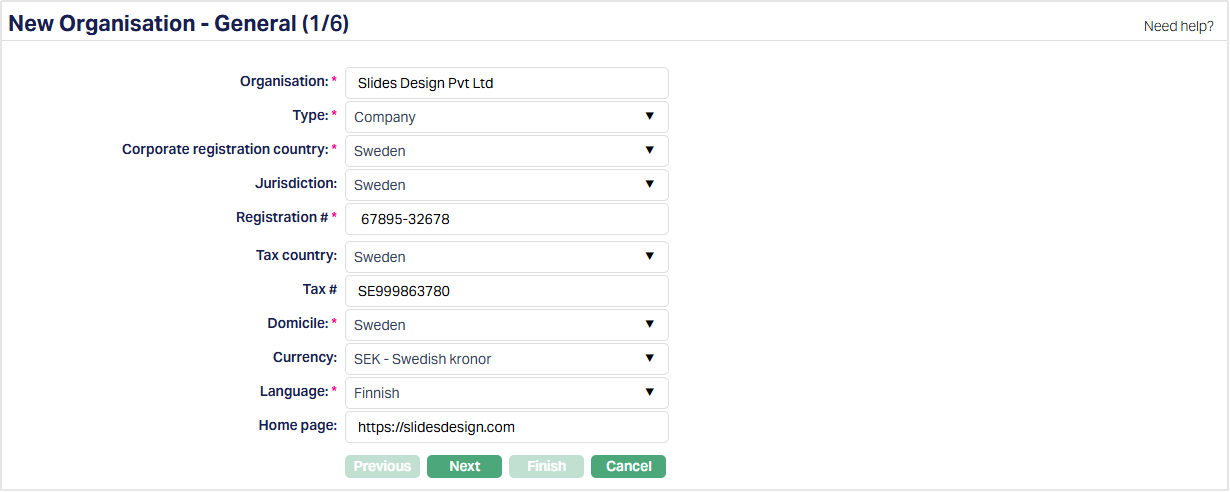
3. Enter name of Organisation.
4. Select Type of the organisation from the drop-down list of countries maintained under Admin → System Codes → Generic Definitions → Organisation Type
5. Select Corporate registration country where the Organisation is/was registered from the drop-down list of countries maintained under Admin → System Codes → Generic Definitions → Countries.
6. Select Jurisdiction in which the organisation works from the drop-down list of countries maintained under Admin → System Codes → Generic Definitions → Countries.
7. Enter Registration # of the Organisation.
8. Select Tax country of the Organisation from the drop-down list of countries maintained under Admin → System Codes → Generic Definitions → Countries.
9. Enter Organisation's Tax # in the Tax country.
10. Select Domicile of the Organisation from the available drop-down list of the countries maintained under Admin → System codes → Generic definitions → Countries.
11. Select Default currency of the Organisation from the drop-down list of active currencies maintained under Admin → System codes → Currencies → Currency Maintenance
12. Select Language for correspondence from the drop-down list of Languages maintained under Admin → System codes → Generic definitions → Languages.
13. Enter website URL for the Home page of the Organisation.
14. Click Next. New Organisation → Address (2/6) page appears.
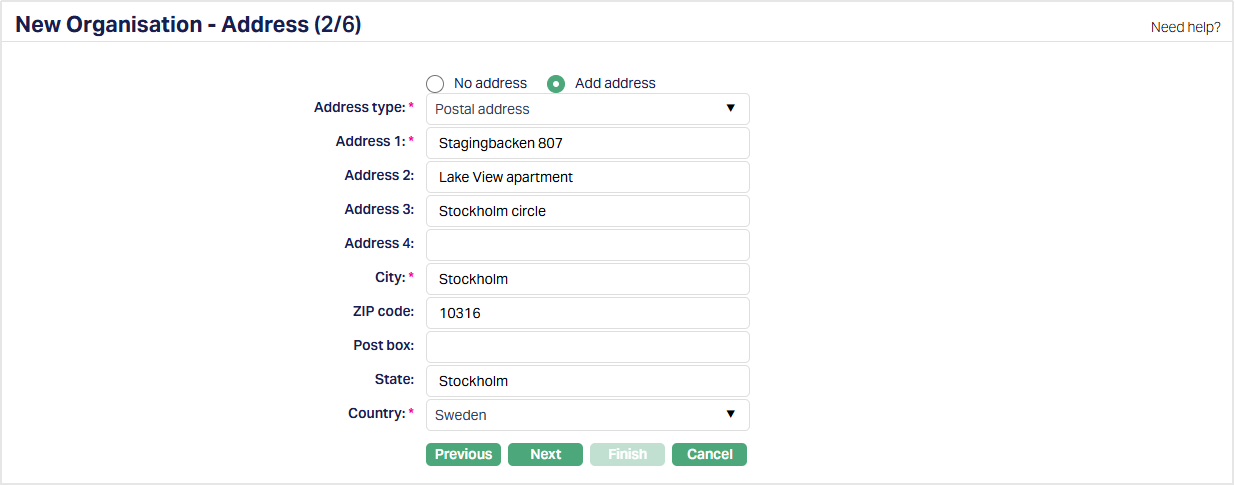
15. By default, No address is selected. If you do not want to record the address of the Organisation at this stage, then you can select this option
16. If you want to enter the address, then click Add address button and provide the required details
17. Select Address type from the drop-down list of Address Types maintained under Admin → System Codes → Address Details → Address types
18. Enter Address 1 ,2, 3 and 4 of the Organisation.
19. Enter City of the organisation.
20. Enter ZIP code of the organisation.
21. Enter Post box of the organisation.
22. Enter State of the organisation.
23. Select Country from the drop-down list of active countries maintained under Admin → System Codes → Generic definitions → Countries.
24. Click Next. Organisation → Phone (3/6) page appears.
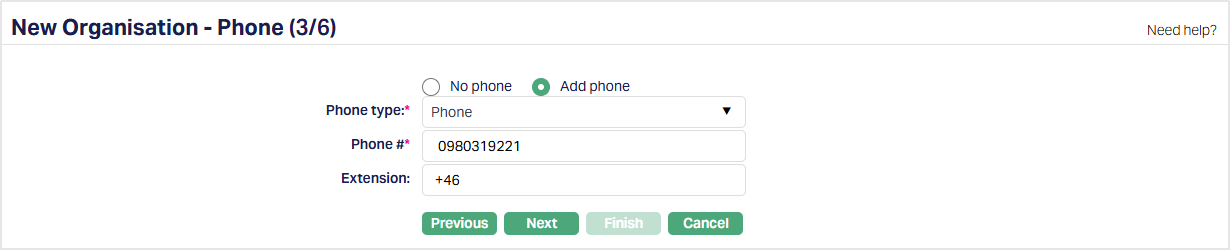
25. By default, No phone is selected. If you do not want to input the phone details at this stage, then you can select this option.
26. If you want to enter the phone details, then click Add phone button and provide the required details.
27. Select Phone type from the drop-down list of active Phone Types maintained under Admin → System Codes → Address details → Phone types.
28. Enter Phone # of the organisation
29. Enter Extension of the phone of the organisation.
30. Click Next. New Organisation → E-mail (4/6) page appears.

31. By default, No E-mail is selected. If you do not want to enter the E-mail details of the organisation at this stage, then you can select this option.
32. If you want to enter the E-mail, then click Add E-mail and provide the required details.
33. Select E-mail type from the drop-down list of email types maintained under Admin → System Codes → Address details → E-mail types.
34. Enter E-mail address of the Organisation.
Note: If custom field is mapped to Organisation Due Diligence under Admin → System Codes → Custom fields → Field mapping, then an additional screen will appear before the confirmation screen. The custom fields will be mandatory or non-mandatory based on the rules set at the Field mappings. For more detail on custom field functionality please refer Admin → System codes → Custom fields → Field mappings manual.
35. Click Next. New Organisation → Custom Field (5/6) page appears.

36. Select the Organisation Start Date.
37. Click Next. New Organisation → Confirmation (6/6) page appears.
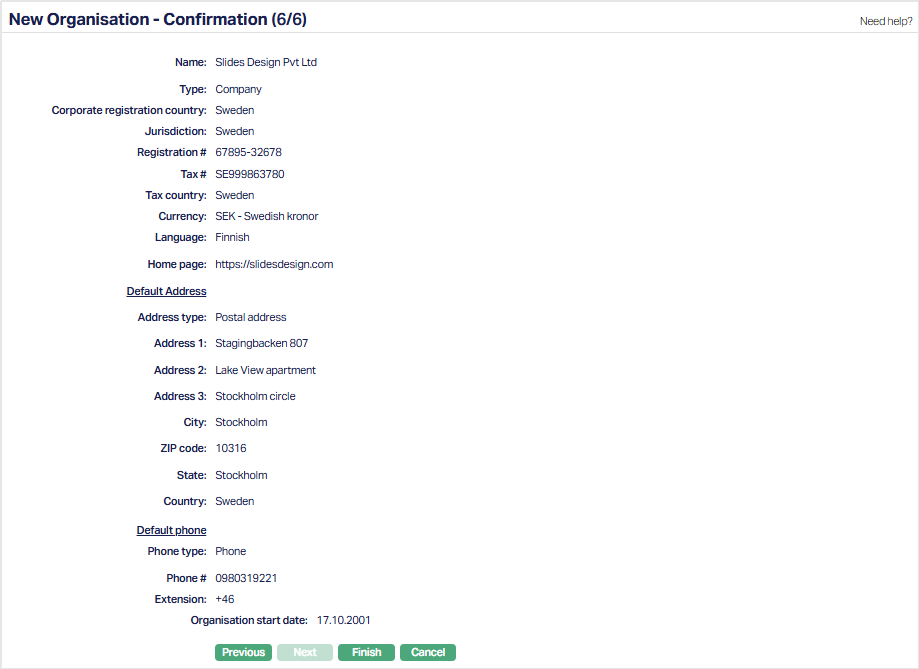
38. Click Finish. Organisation details are added with a unique Organisation # and you will see the Organisation Due Diligence window displaying the Identification Tab by default. Due Diligence Status will be Pending.
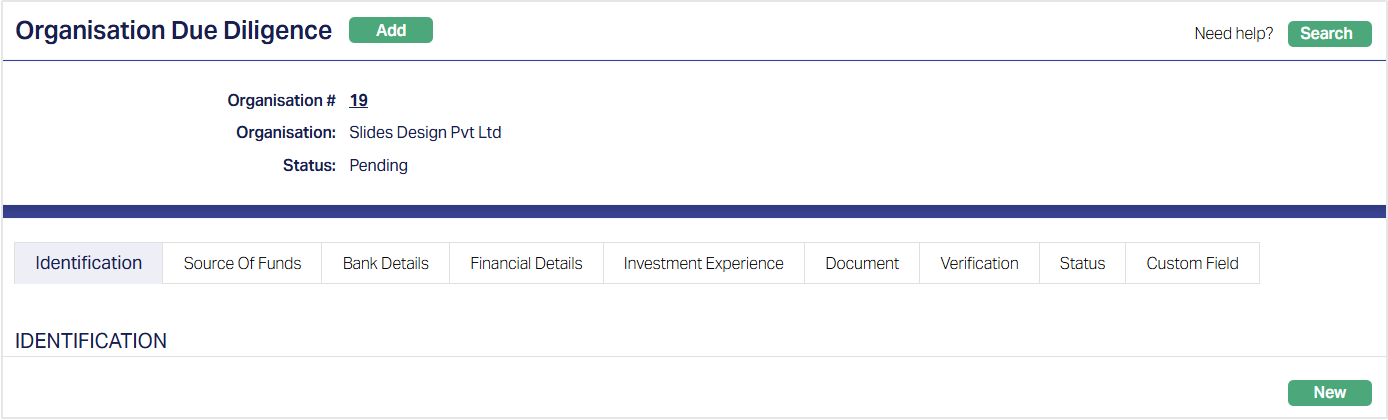
Functions: Add and Search
Note: If the custom field is mapped to Organisation / Organisation Due Diligence under Admin → System Codes → Custom fields → Field mapping, then additional screen(s) will appear before the Confirmation screen. The custom fields will be mandatory or non mandatory based on the rules set at the Field mappings. For more details on custom field functionality please refer Admin → System codes → Custom fields → Field mappings manual.
Identification
Identification tab allows you to create and maintain the organisation's identification details.
To add a New Identification,
1. Access Organisation Due Diligence page.
2. Click Identification tab.

3. Click New button. New Identification page appears.
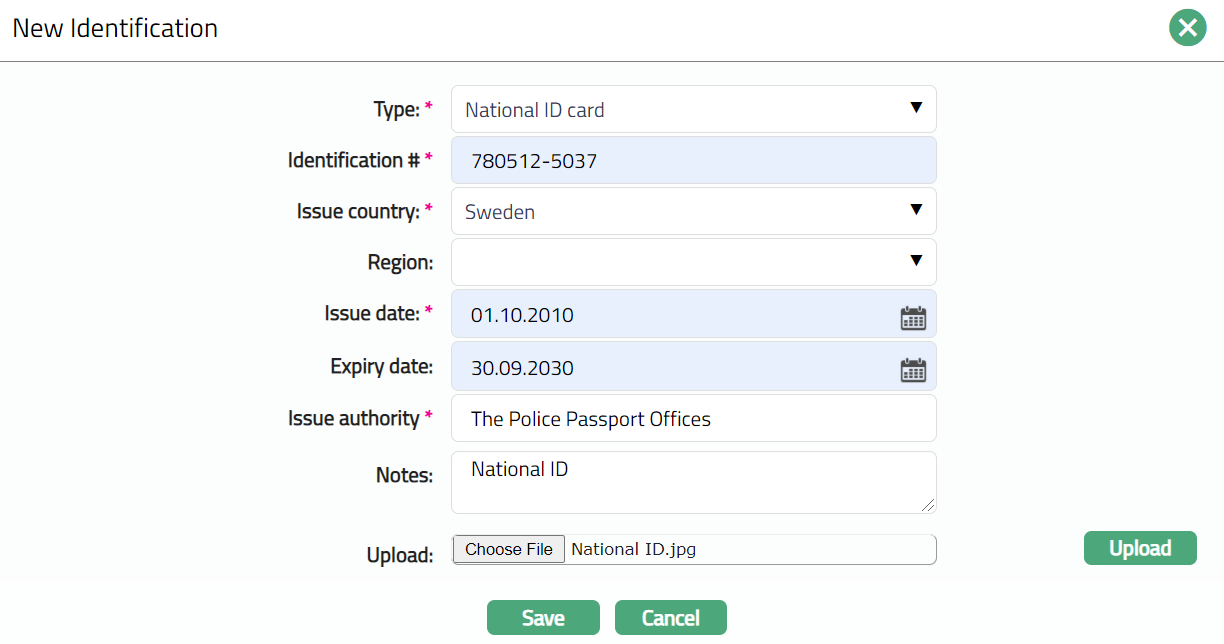
4. Select Type from the drop-down list maintained under Admin → System Codes → Generic Definition → Identification Type. It is the identification type provided by the organisation for performing due diligence.
5. Enter Identification # of the Identification document.
6. Select Issue country from the drop-down list. It is the country where the organisation's identification document is issued. The countries are maintained under Admin → Generic definition → Country
7. Select Region from the drop-down list. Aura will display the region based on the above selected Issue country. The regions are maintained under Admin → System codes → Address details → Region.
8. Enter issue date of the identification document in Issuedate. You can enter the date by clicking on the date picker located to the right and choosing the date OR by manually entering the date in the field itself. You cannot enter a future date.
9. Enter the expiry date of the identification document in Expirydate. You can enter the date by clicking on the date picker located to the right and choosing another date OR by manually entering the date in the field itself. You cannot enter a past date. The expiry date will be mandatory only on selecting the option as passport and driving licence in type.
10. Enter Issue Authority. It is the Organization / Office that has issued the Identification document.
11. Enter Notes, if any.
12. You can Upload the scanned image of the identification document. Click on the browse button to select the file. Then click on upload button to upload the document to Aura. Once the document is uploaded, you can view that document in Branch view → Documents. If you try to upload document other than the Image files (. jpg, gif. jepg, .png, .tif, .bmp), on click of Save system will through an error message as "Invalid file format."
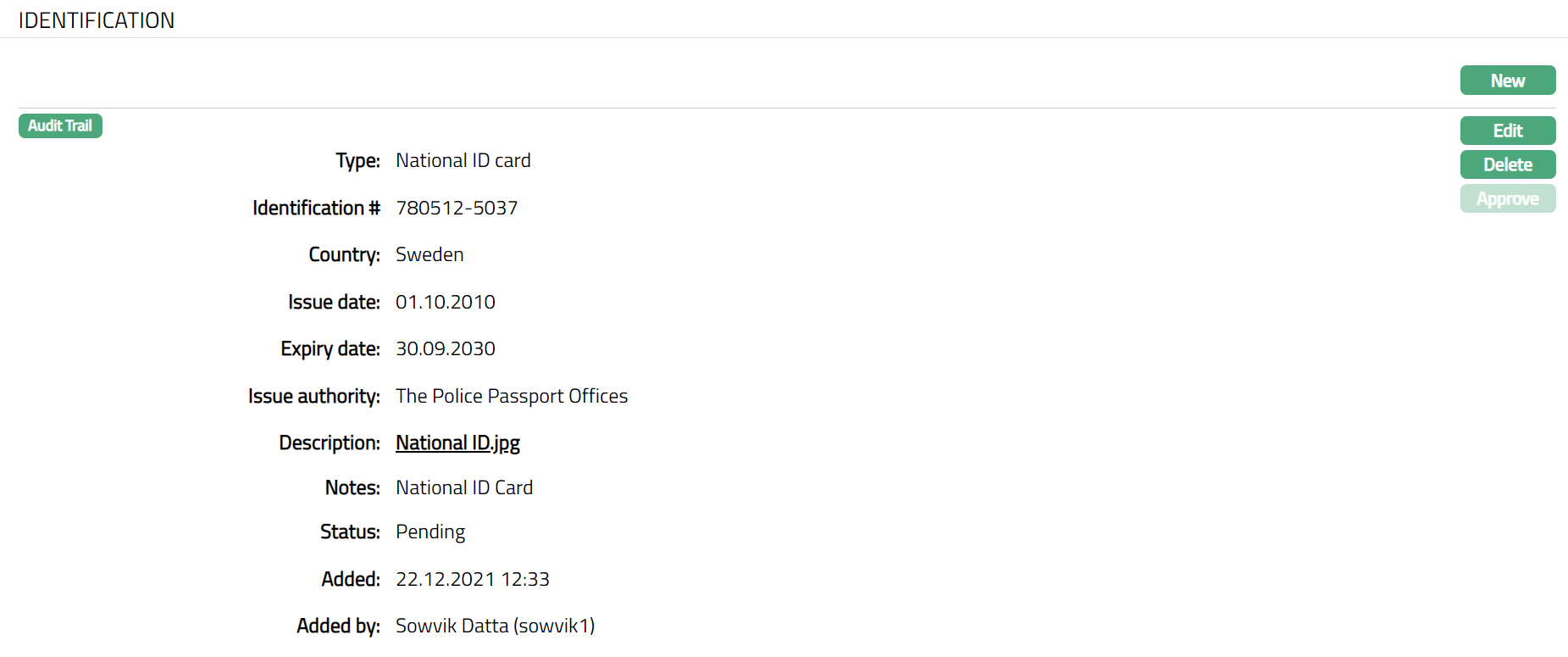
13. Click Save. Identification page will appear with the added details.
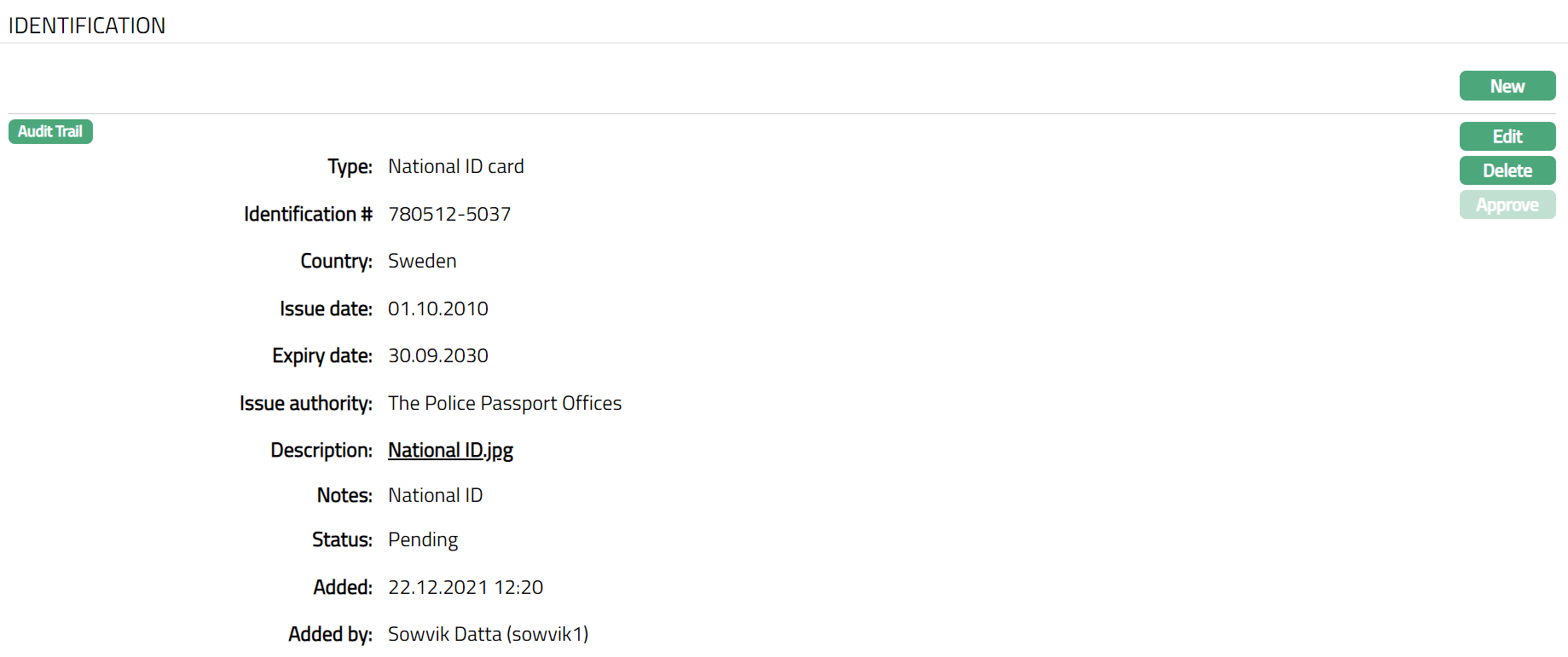
Functions: New, Edit, Delete, Approve
Note: On addition of a new record / edit, the tab Status appears as pending. Only on Approval by authorized person, the Status becomes Approved
The additional fields that you can view / edit in the tab are explained below:
Description denotes the uploaded document with a Hyperlink. To view the document, you need to click the hyperlink.
Status field denotes the status of the tab.
Added field denotes the date on which the record was added.
Added by field denotes the name of the user who created the record.
Approved field denotes date and time on which the record was approved and is displayed only for approved records.
Approved by field denotes name of the official who approved the record and is displayed only for approved records
Delete: You can delete Identification record saved in Aura by a click on Delete button. Aura will ask for confirmation, on approving which the selected record will be deleted. Once the record is approved, it cannot be deleted.
Approve: If you want to approve an Identification record, then retrieve the record and click on Approve. Aura will ask for confirmation. Once the tab is approved by the authorized person, status gets changed from Pending to Approved.
To edit Identification record,
1. Access Organisation Due Diligence page and click Identification tab.
2. Click Edit. Edit Identification page appears.
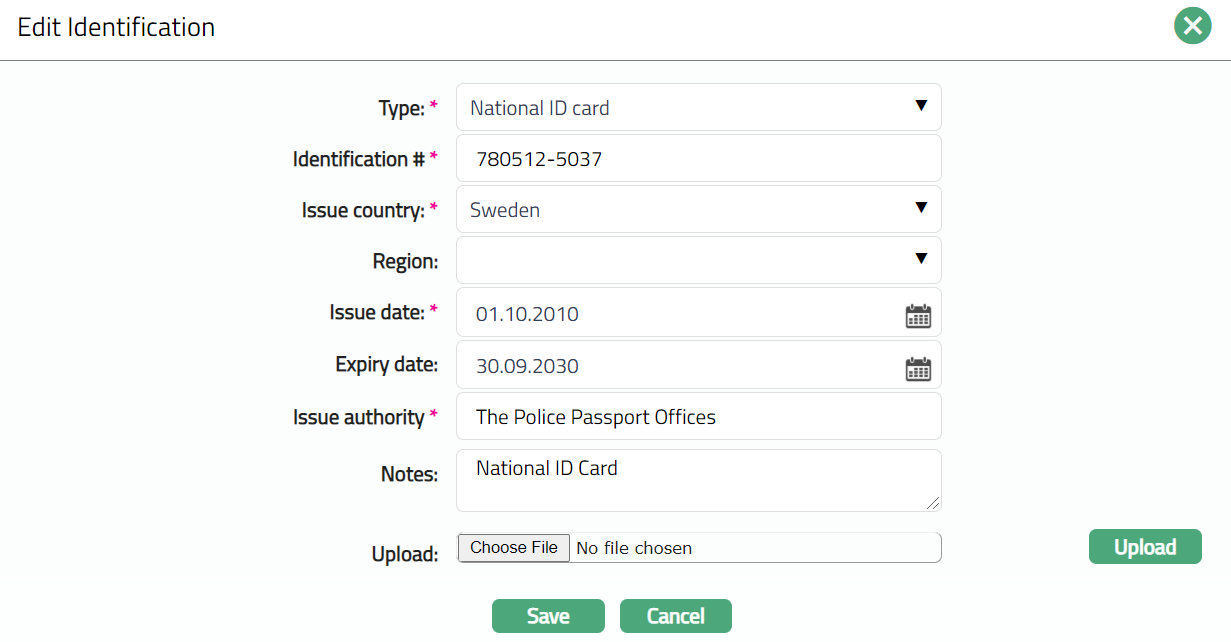
Note: All fields are editable.
3. Make required changes and click Save. Identification tab appears with the edited details.
Functions: New, Edit, Delete, Approve
Source of Funds
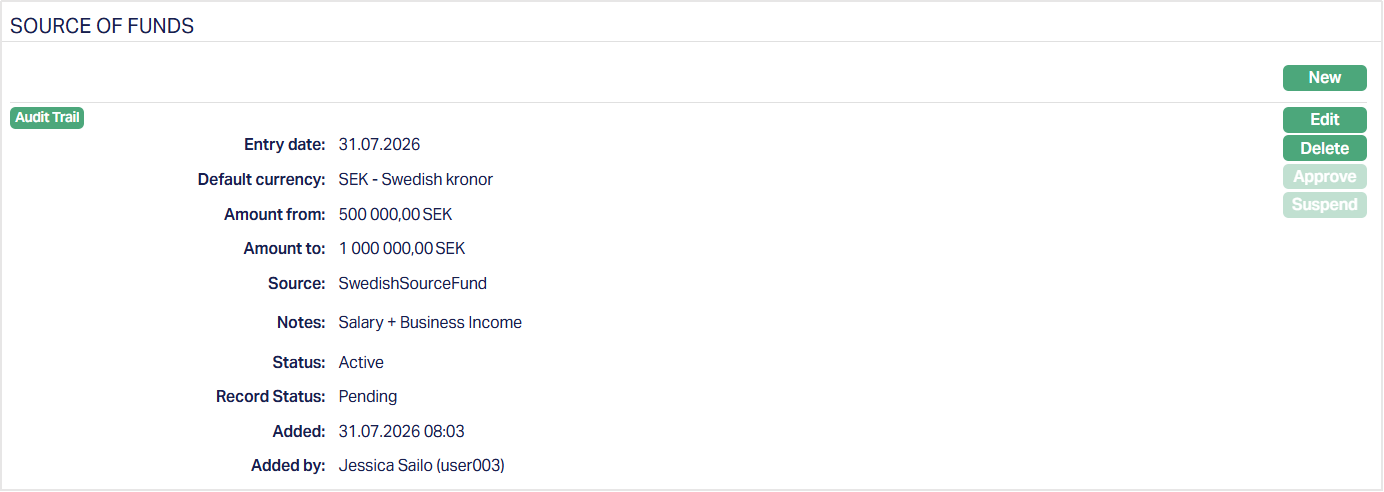
Source of Funds tab allows you to create and maintain the source of funds details. It refers to where an organisation got hold of or received the funds being deposited
To Add New Source of Funds,
1. Access Organisation Due Diligence page.
2. Click Source of Funds tab.

3. Click New button. New Source of Funds page appears.
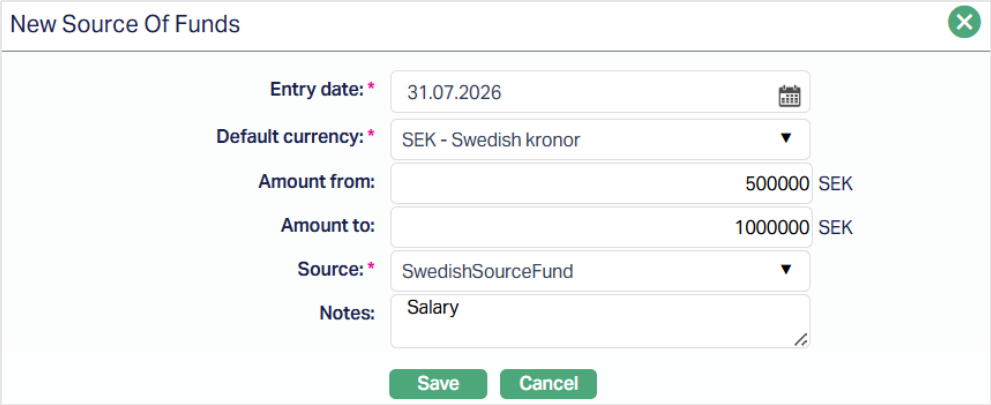
4. Enter date of entry for the deposit in Entry date. By default, the date will be the current date. You can change it by clicking on the date picker located to the right and choosing another date OR by manually changing the date in the field itself.
5. Default Currency is the currency in which the amount is deposited. Select the Default currency from the drop-down list of active currencies maintained under Admin → System codes → Currency.
6. Enter the lower limit of the range in Amount from. Aura will allow you to enter any amount greater than zero.
7. Enter the upper limit of the range in Amount to. Aura will allow you to enter any amount greater than or equal to Amount from.
8. Source is the source from which the fund will be deposited. Select the Source from the drop-down list maintained under Admin → System codes → Payments → Source of fund.
9. Enter Notes if any.
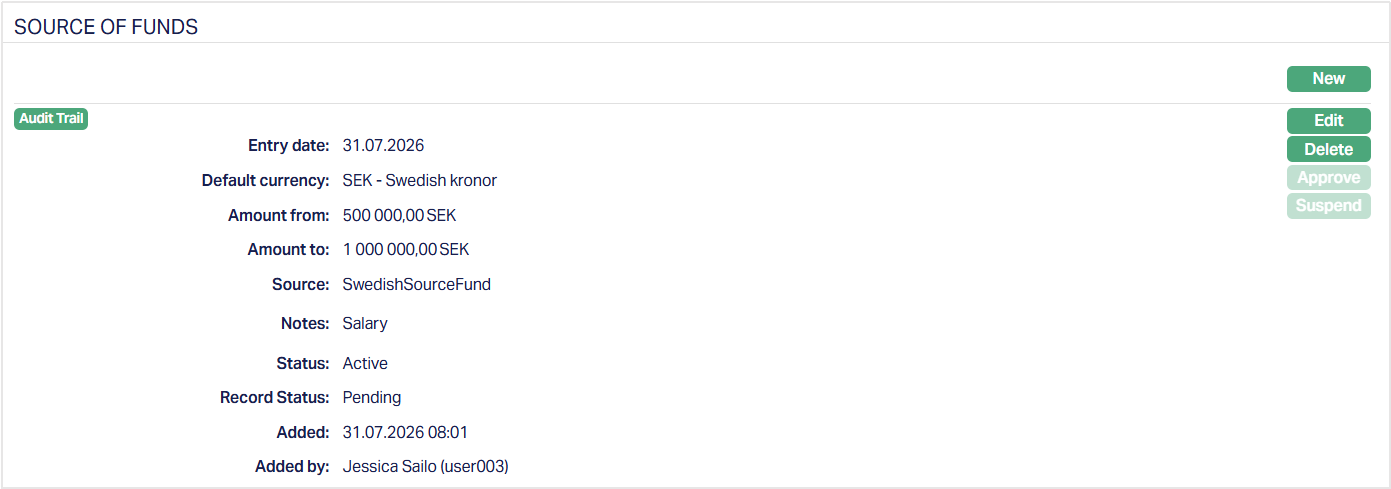
10. Click Save. Source of Fund Page appears with the added details.
Functions: New, Edit, Delete, Approve, Suspend, Activate
Note: On addition of a new record / edit, the tab Status appears as Pending. Only on Approval by authorized person, the Status becomes Approved
The additional fields that you can view / edit in the tab are explained below:
Status field denotes the status of the record
Added field denotes the date on which the record was added.
Added by field denotes the name of the user who created the record.
Approved field denotes date on which the record was approved and is displayed only for approved records.
Approved by field denotes name of the user who approved the record and is displayed only for approved records.
Delete: You can delete Source of Fund record saved in Aura by a click on Delete button. Aura will ask for confirmation, on approving the selected record will be deleted. Once the record is approved, it cannot be deleted.
Approve: If you want to approve a Source of Fund record, then retrieve the record and click on Approve. Aura will ask for confirmation. Once the tab is approved, status gets changed from Pending to Approved.
Suspend: You can suspend a Source of Fund record by clicking on Suspend button. When you click on Suspend button, Aura will ask for confirmation. On confirmation, Aura will suspend the Source of Fund record. Suspended records can be activated by using Activate button.
To edit the Source of Funds record,
1. Access Organisation Due Diligence page and click Source of Funds tab.
2. Click Edit. Edit Source of Funds page appears
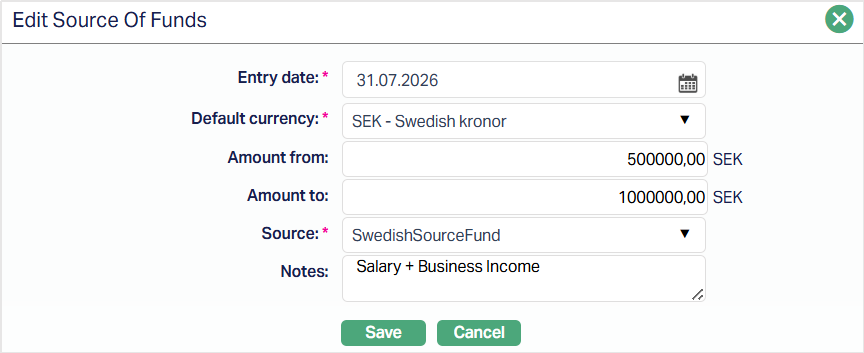
Note: All fields are editable.
3. Make required changes and click Save. Source of Funds page appears with the edited details.
Functions: New, Edit, Delete, Approve, Suspend, Activate
Bank Details
Bank details tab allows you to maintain the bank details of the organisation.
To add New Bank Details,
1. Access CRM → Due Diligence → Organisation page.
2. Click Bank Details tab.

3. Click New button. New Bank Details page appears.
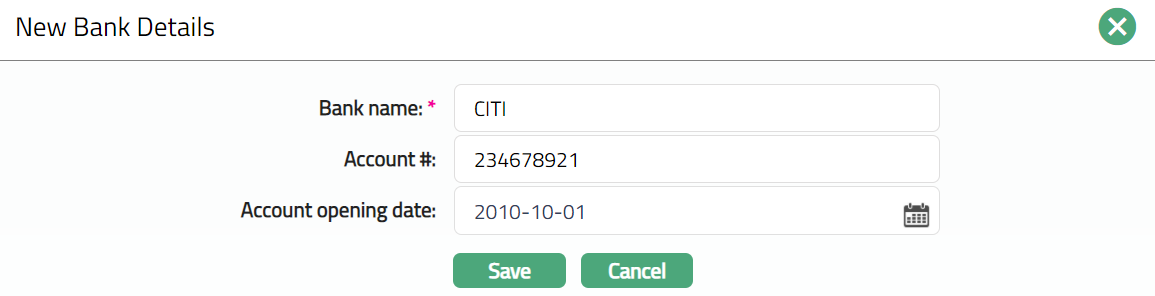
4. Enter Bank name where the organisation holds the account.
5. Enter Account # of the organisation in that bank.
6. Enter date on which the above account was opened under Account opening date. By default, the date will be the current date. You can change it by clicking on the date picker located to the right and choosing another date OR by manually changing the date in the field itself. You cannot enter a future date.
7. Click Save. Bank Details Page appears with the added details.

Functions: Add, Edit, Delete
Delete: You can delete Bank Details record saved in Aura by a click on Delete button. Aura will ask for confirmation, on approving which the selected record will be deleted.
To edit Bank Details record,
1. Access Organisation Due Diligence page and click Bank Details tab.
2. Click Edit. Edit Bank Details page appears.
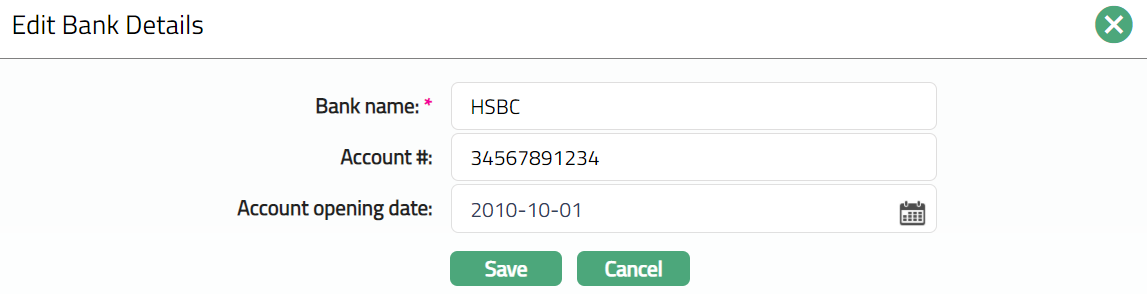
Note: All fields are editable.
3. Make required changes and click Save. Bank Details page appears with the edited details.

Functions: Add, Edit, Delete
Financial Details
Financial Details are the snapshot of any Organisation financial position at a specific point of time. It lists Organisation assets (what they own), total revenue (the total amount of income generated), balance sheet value (which shows a company's financial position at a point in time), equity (the amount of capital invested or owned by the owner of a company, or the value of the shares issued by a company), operating income or loss of the company, origin of assets, Organisation liabilities (what they owe), their investments (where they invested), their regular expenditure etc.
Using the Financial Details tab, you can maintain the Financial Details mapped to the Organisation.
To Add new Financial details,
1. Access CRM → Due Diligence → Organisation page and click Financial Details tab.

2. Click New. New Financial Details page appears.
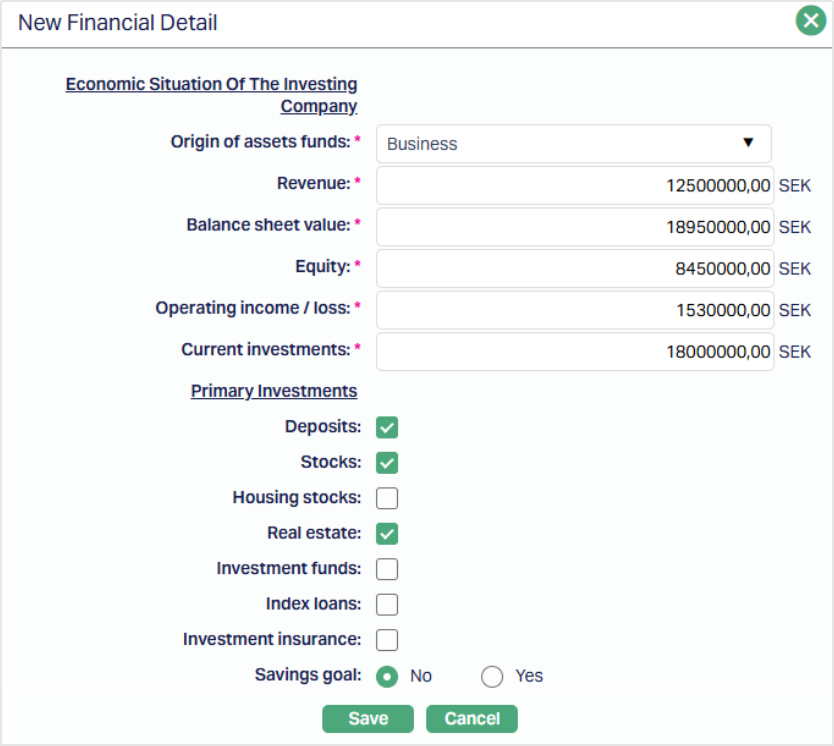
3. Select Origin of Assets Funds from the drop-down list.
Note: These are pre-shipped values.
4. Enter value of the total Revenue for the organisation.
5. Enter value of Balance Sheet of the organisation.
6. Enter value of Equity of the organisation.
7. Enter value of Operating income / loss for the organisation.
8. Enter value of Current investments of the organisation.
9. Select instruments into which the Organisation has invested from the mentioned list under Primary Investments
Savings Goal
10. Select the Saving goals as Yes or No. By default, the value is set to No.
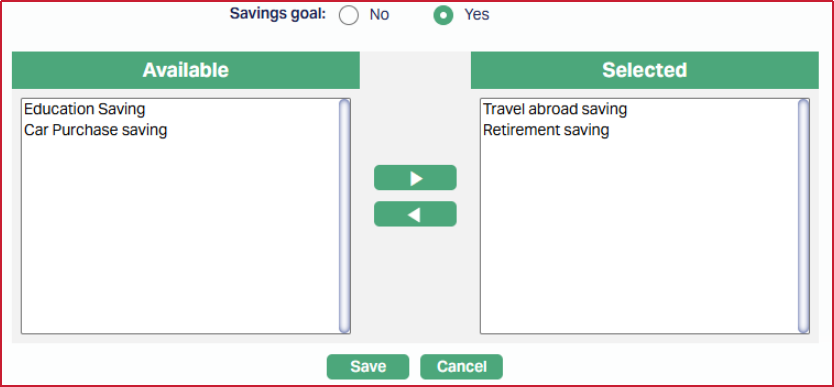
- If you select No - the savings goal values will not be displayed and no further action is required.
- If you select Yes - Aura displays a selection panel to choose the savings goal values. The available values are derived from the list maintained under Admin → System Codes → Generic Definitions → Purpose of Savings.
Select the required values from the Available list and move them to the Selected list. You can select more than one savings goal as required
11. Click Save. Financial Details page appears with updated details.
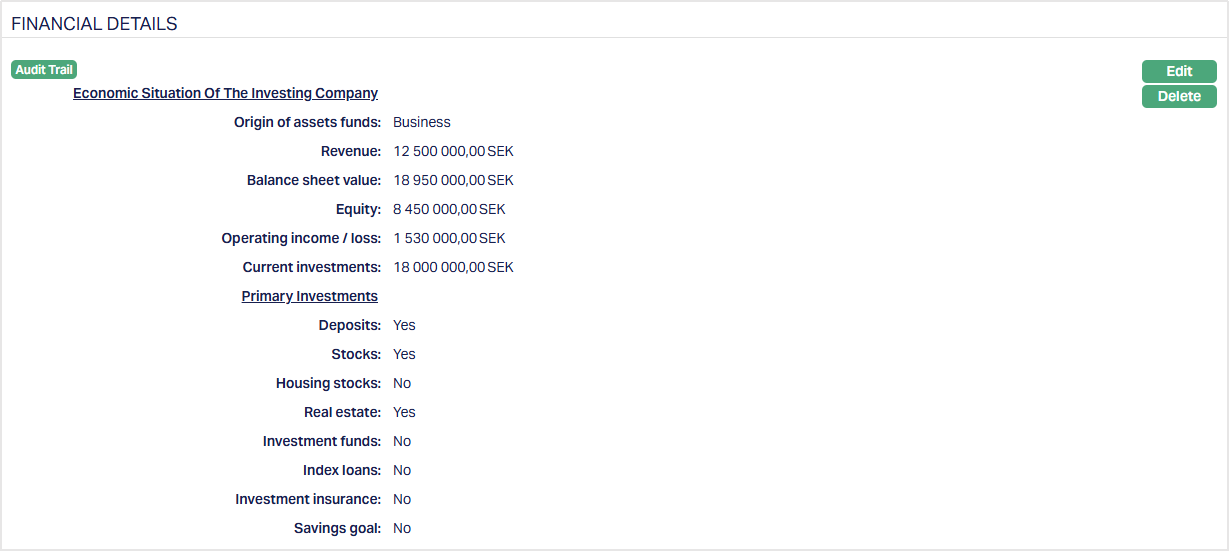
Functions: New, Edit, Delete
Delete: You can delete the Financial Details record saved in Aura by a click on Delete button. Aura will ask for confirmation, on approving which the selected record will be deleted.
To edit Financial Details record,
1. Access Organisation Due Diligence page and click Financial Details tab.
2. Click Edit. Edit Financial Details page appears.
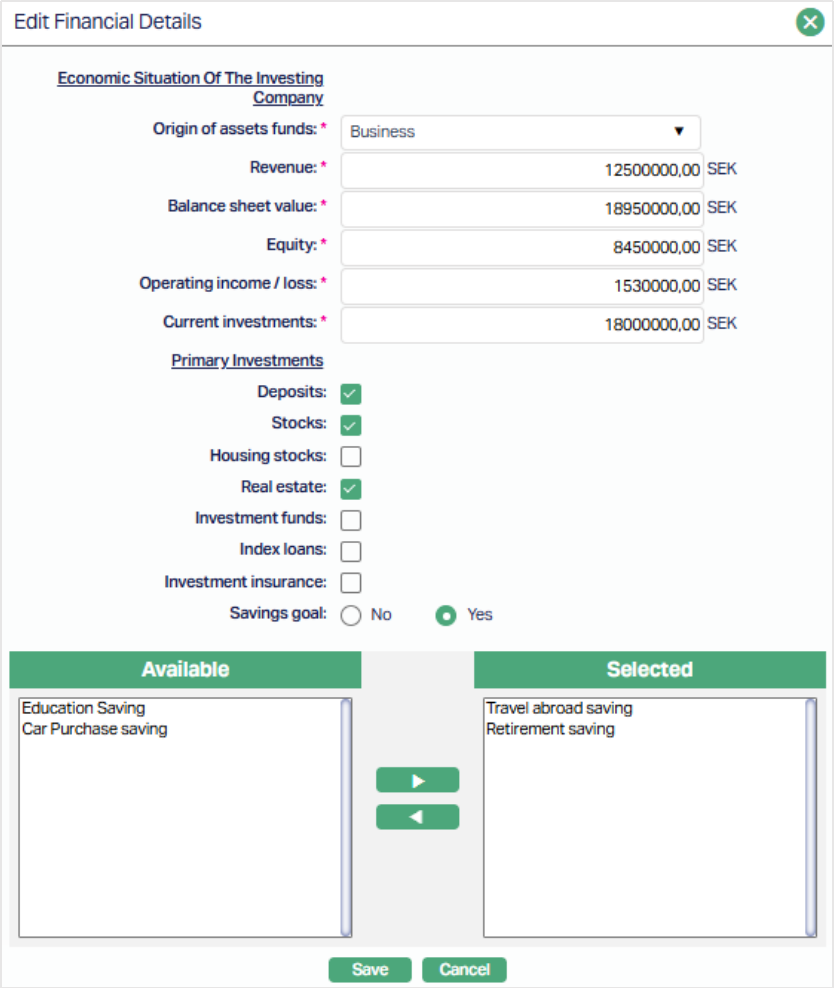
Note: All fields are editable.
3. Make required changes and click Save. Financial Details tab appears with the edited details.
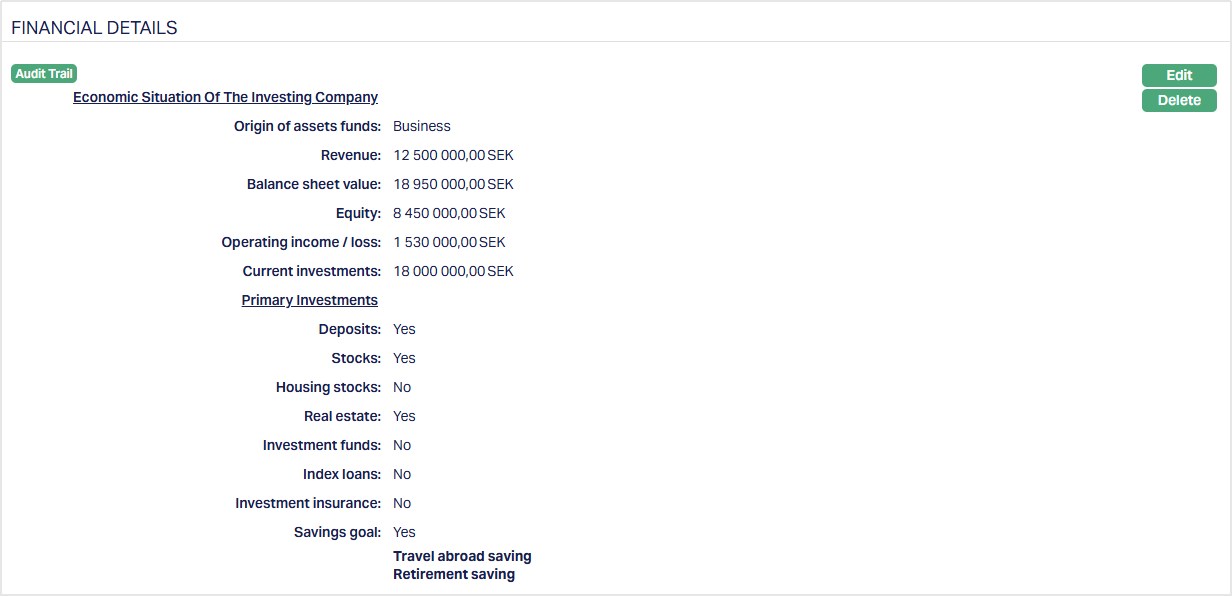
Functions: New, Edit, Delete.
Investment Experience
Investment Experience tab allows you to define the accumulation of investment knowledge or skill that results from direct participation in market events or investment activities. You need to select the relevant investment parameters against each Investment type.
The tab contains two sub-tabs:
- Details
- Assessment
You can use these sub-tabs to record the investment profile of the person and maintain the assessment history.
Details
The Details sub-tab allows you to capture the person's overall investment profile. This includes the types of financial instruments handled, investment behaviour, experience level, and risk appetite. The information maintained here forms the basis for evaluating the organisation's investment knowledge and supports the classification recorded in the Assessment sub-tab.
To add Investment Experience details,
1. Access the Organisation Due Diligence page and click the Investment Experience tab, select the Details sub-tab which is the default tab. When a new organisation record is created, this tab does not display any records by default.

2. Click New. The New Investment Experience page appears.
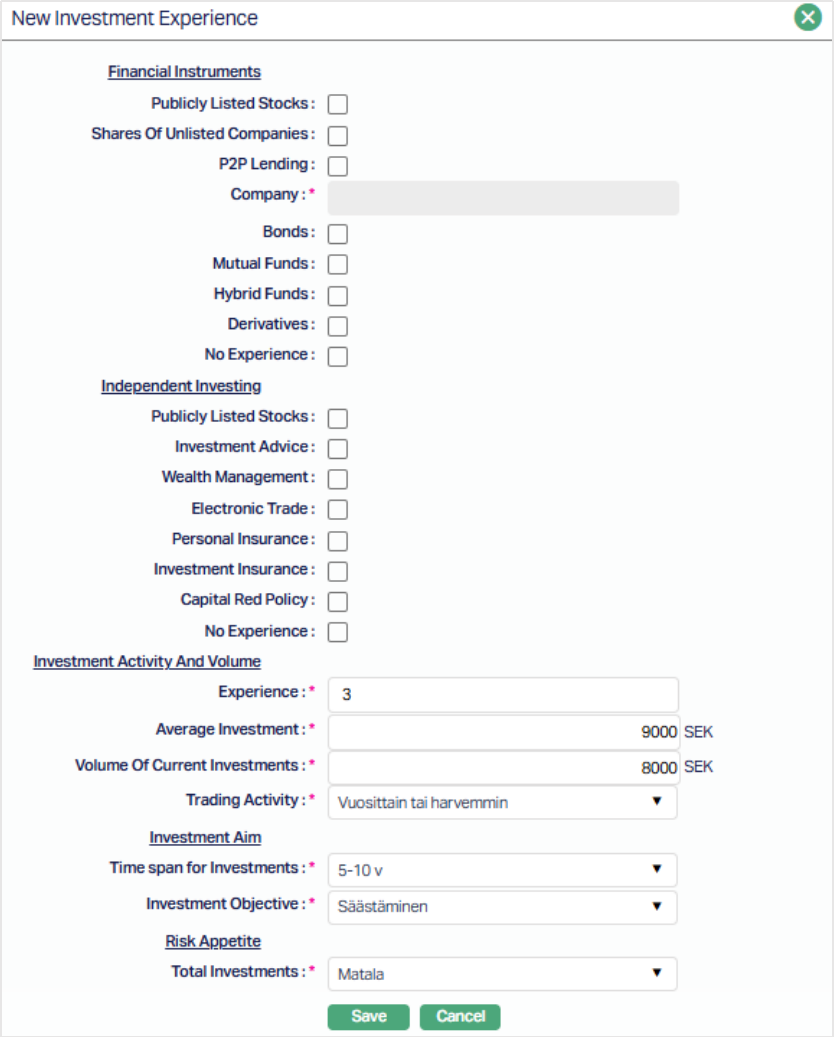
3. Under Financial Instruments - Select the types of instruments in which the person has prior or current investment experience. This provides an indication of the organisation's exposure to different investment products.
4. Under Independent Investing - Select the applicable options that describe how the organisation manages or participates in investment activities, such as whether investments are self-directed or managed through advisory services.
5. Under Investment Activity and Volume, enter the required information:
- Experience - Enter the number of years or duration of the person’s investment experience.
- Average Investment - Enter the typical investment amount made by the person.
- Volume of Current Investments - Enter the approximate total value of current investments held by the person.
- Trading Activity - Select how frequently the person undertakes investment or trading activity.
6. Under Investment aim, enter the required information:
- Time Span for Investments - Select the typical investment horizon followed by the person.
- Investment Objective - Select the primary objective of the person’s investments, such as wealth accumulation or savings.
7. Under Risk Appetite, enter the required information:
- Total Investments - Select the appropriate range representing the person’s overall investment holdings.
All mandatory fields must be completed.
8. Click Save. The Details sub-tab appears with the added details.
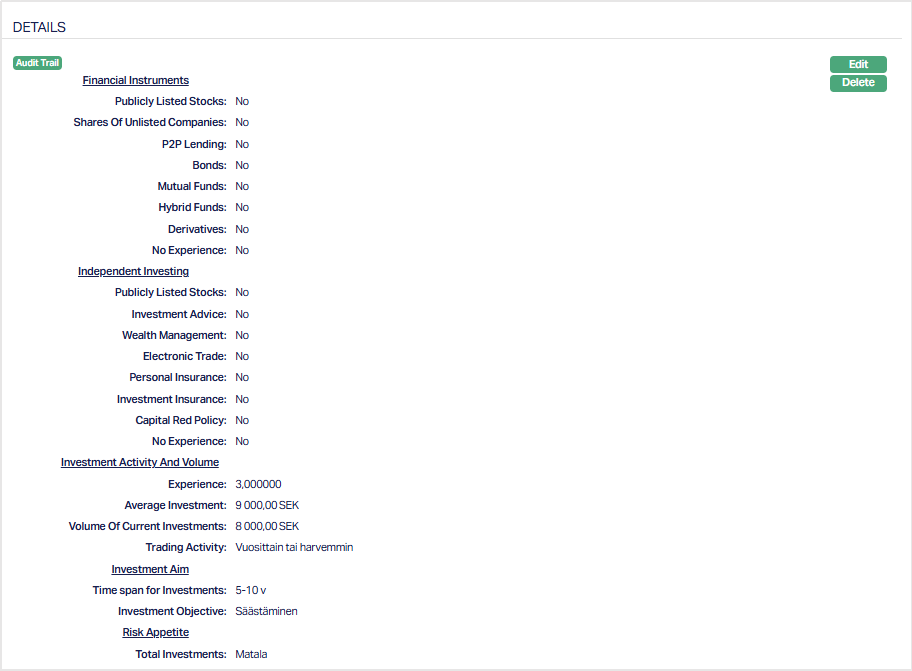
Functions: Edit, Delete.
To edit,
1. Click Edit. Edit Investment Experience page appears.
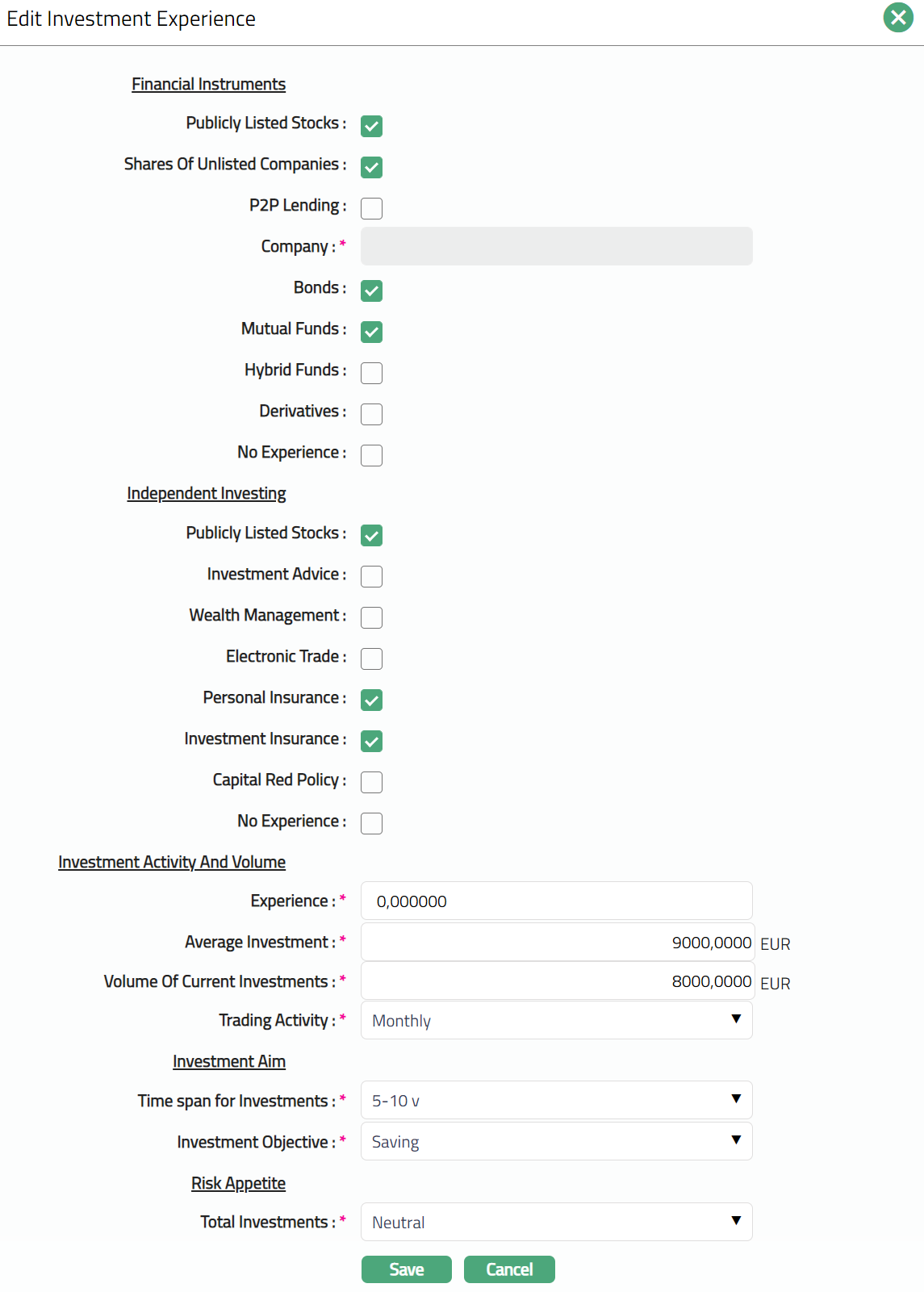
Note: All fields are editable.
2. Make the required changes and click Save. The Details sub-tab appears with the edited details.
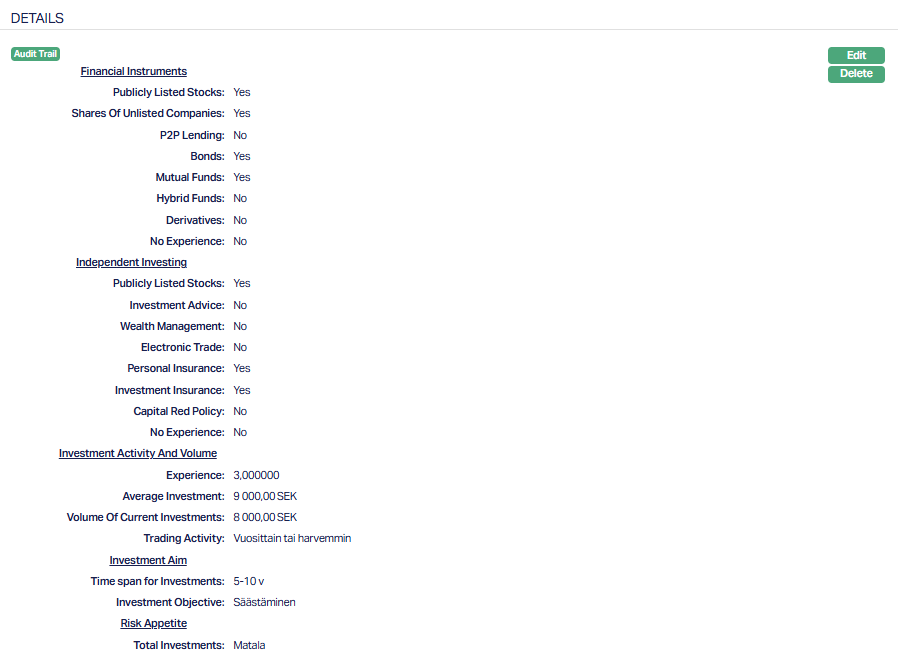
Functions: Edit, Delete.
Assessment
The Assessment sub-tab allows you to evaluate the organisation’s investment knowledge and classify the organisation as a Sophisticated or Non-Sophisticated investor. This classification is used for regulatory, compliance, and suitability purposes and must be periodically reviewed.
Multiple assessment records can be maintained over time to track changes in the organisation's investment experience and classification.
To add assessment details,
1. Access the Organisation Due Diligence page and click the Investment Experience tab and select the Assessment sub-tab. When a new organisation record is created, this tab does not display any records by default.

2. Click New. The New Assessment page appears.
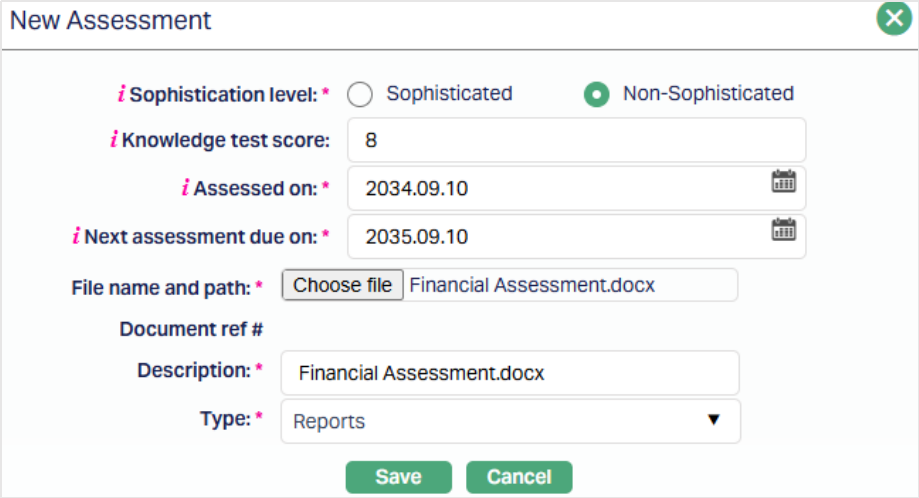
3. Sophistication Level - Select whether the person is classified as:
- Sophisticated
- Non-Sophisticated (Default)
This classification indicates whether the organisation has sufficient knowledge and experience to evaluate investment risks independently.
4. Knowledge Test Score - Enter the score obtained by the person in any knowledge or suitability test conducted. This field is optional and may be used to support the classification decision.
5. Assessed On - Enter the date on which the investment experience evaluation was performed. By default, the current date is displayed and can be changed to a past date if required.
6. Next assessment due on - Enter the date on which the next evaluation must be carried out. If Sophistication level is selected as:
- Sophisticated - The next assessment due date defaults to two years from the Assessed on date.
- Non-Sophisticated - The next assessment due date may default from the Due for Review On date maintained under the Verification tab. You can modify this date if required.
The next assessment due date must be the same as or later than the Assessed on date.
7. File name and path - You can upload a supporting document related to the assessment, such as evaluation forms or declaration. Description and Document type must be provided.
8. Click Save. The Assessment sub-tab appears with the added details.
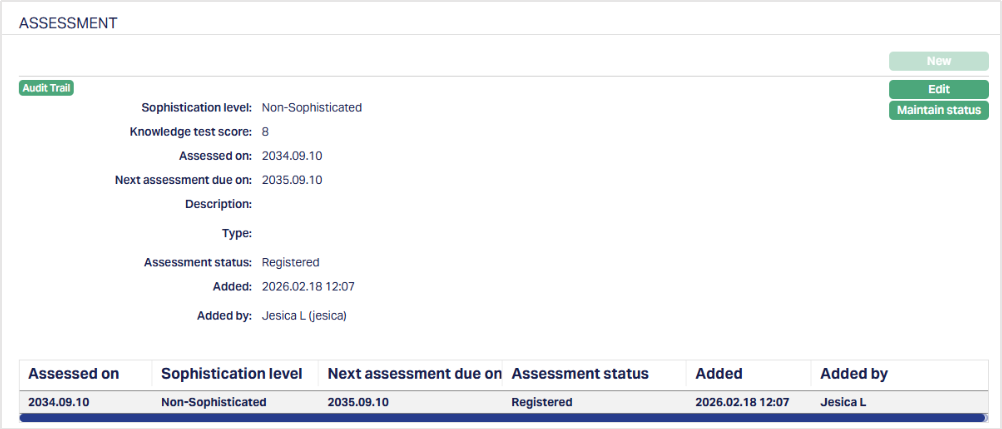
Functions: New, Edit, Maintain Status.
Over time, additional assessment records can be added to maintain the history of classification and reviews.
New: The New button allows you to create a new assessment record for the organisation. When no assessment record exists, the New button is enabled for all users. After an assessment record is created, the New button will be enabled only when the previous assessment record has been completed with a final status - Accepted or Rejected. This ensures that multiple active assessment records are not maintained simultaneously.
To edit an Assessment,
1. Click Edit. The Edit Assessment page appears.
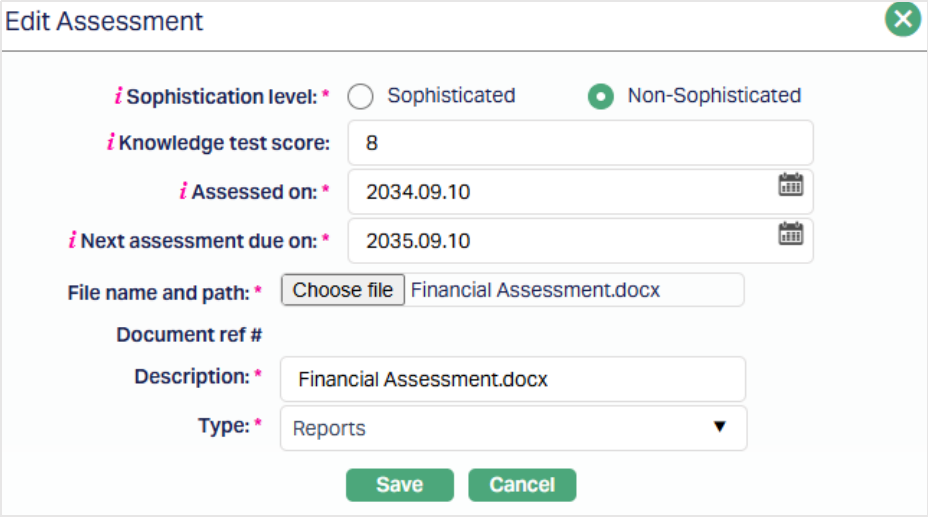
Note: All fields are available.
2. Make the required changes and click Save. The Assessment sub-tab appears with the edited details.
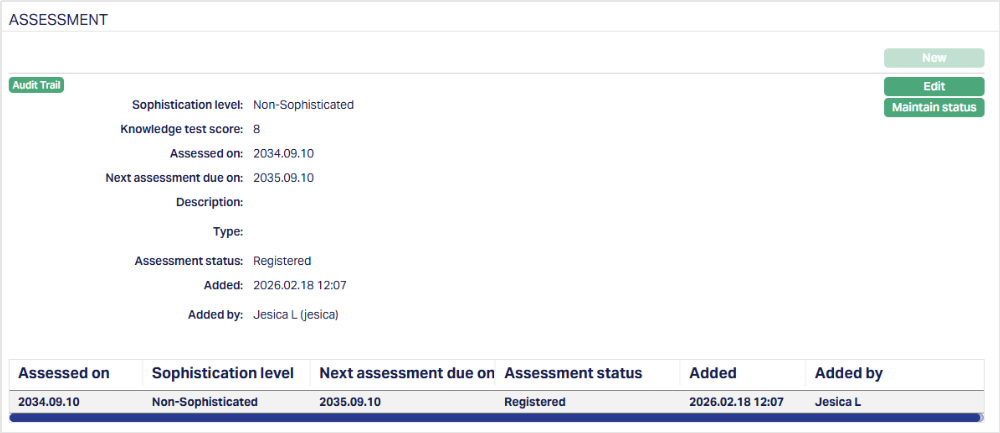
Functions: New, Edit, Maintain Status.
Maintain Assessment Status
Aura allows you to record whether the assessment has been accepted or rejected through the status maintenance tab.
To update the assessment status,
1. Access the Assessment sub-tab and select the required record. Click Maintain Status and the Status tab appears.
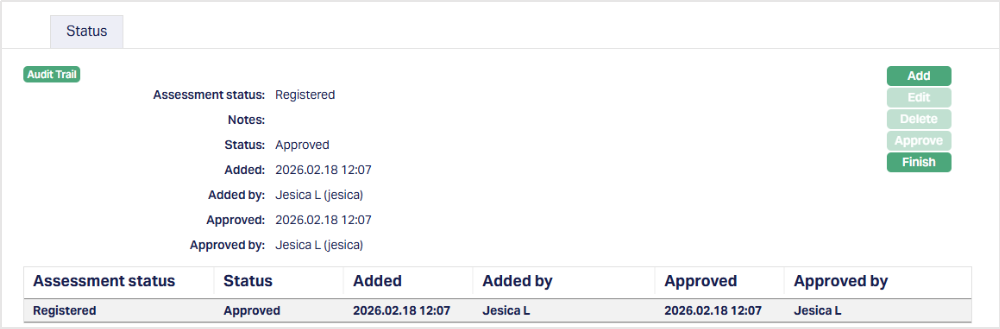
2. Click Add. The Add Status page appears.
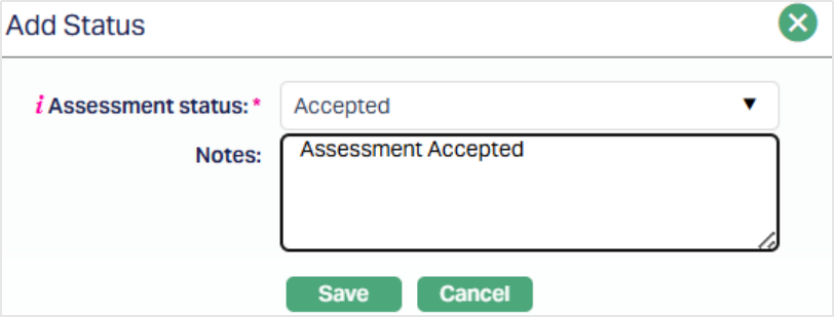
3. Select the Assessment Status from the drop-down. This will either be - Accepted or Rejected.
4. Enter the reason in the Notes field.
5. Click Save. The Status tab appears with the updated status.
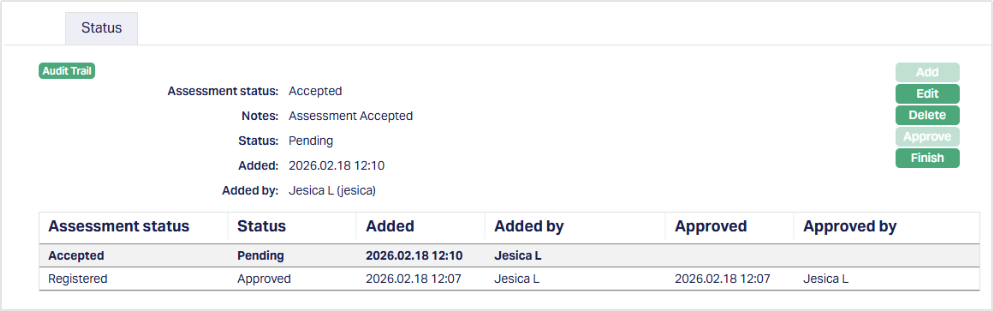
Status of the record is Pending till it is approved by another user. On approval, the tab status is set to Approved and the Assessment status is changed from Registered to Accepted.
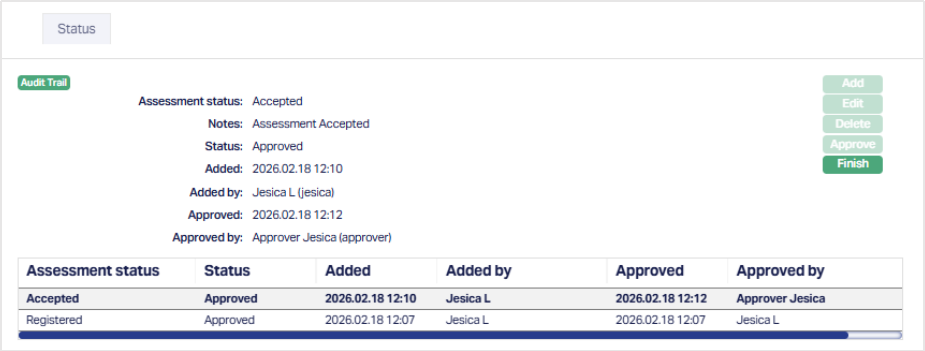
Functions: Add, Edit, Delete, Approve, Finish.
The additional fields that are shown are:
- Status indicates the current state of the record. It will be either: Pending - If the record is waiting for approval or Approved - If the record has been reviewed and finalized.
- Added shows the date and timestamp when the record was created and Added by displays the user ID and full name of the person who created the record.
- Approved shows the date and time when the record was approved and Approved by displays the user ID and full name of the person who approved the record.
Document
Document tab allows you to upload documents related to the Organisation. These can be in the form of scanned images or files on your computer. You can categorise the documents as per Document Type and store with a document reference number. You can also view the documents that were uploaded using this tab or from Organisation Maintenance → Documents tab.
To add New Document,
1. Access Organisation Due Diligence page.
2. Click Document tab.

3. Click New. New Document page appears
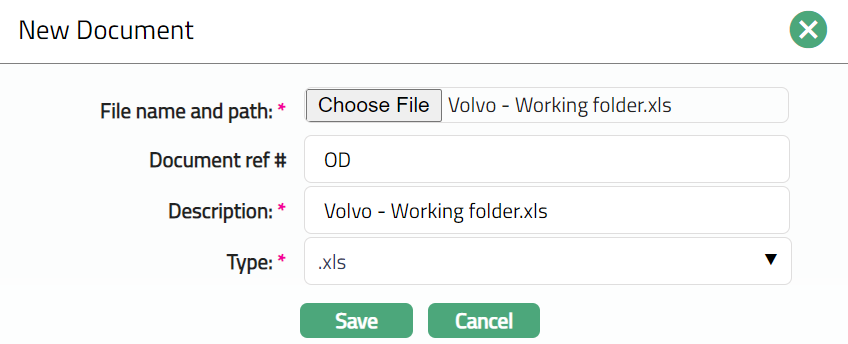
4. Click Choose File button to select the File name and path of the document.
5. Enter Document ref number for the document.
6. Based on the file selected the Description field will be derived. If required, you can change the description.
7. Select Type of the Document uploaded from the list of Document Types maintained under Admin → Documents → Document type. Once entered, this cannot be edited.
8. Click Save. Document page appears with the added details.
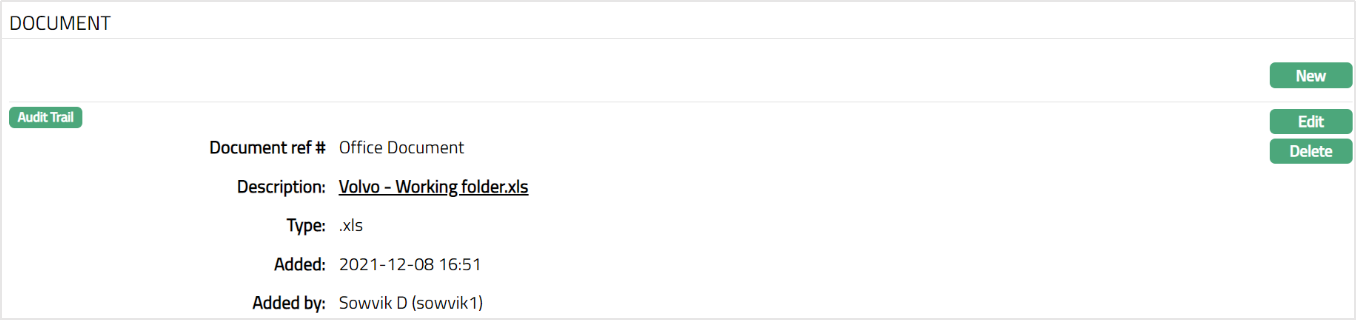
The additional fields are as follows:
Added field denotes the date on which the record was added.
Added by field denotes the name of the user who created the record.
Delete: You can delete a Document record saved in Aura by a click on Delete button. Aura will ask for confirmation, on approving which the selected record will be deleted.
To edit Document record,
1. Access Organisation Due Diligence page and click Document tab.
2. Click Edit. Edit Document page appears.
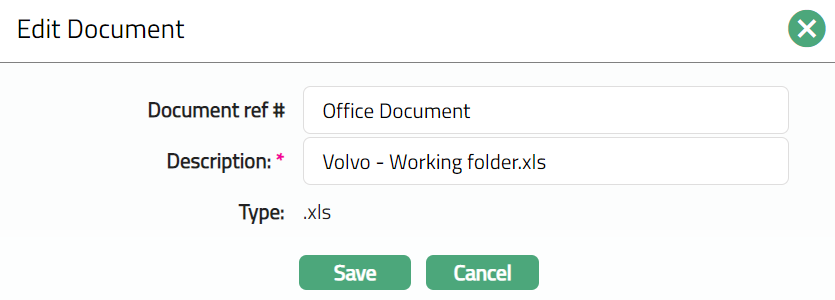
Note: Except Type field, rest all other fields are editable.
3. Make required changes and click Save. Document page appears with the edited details.
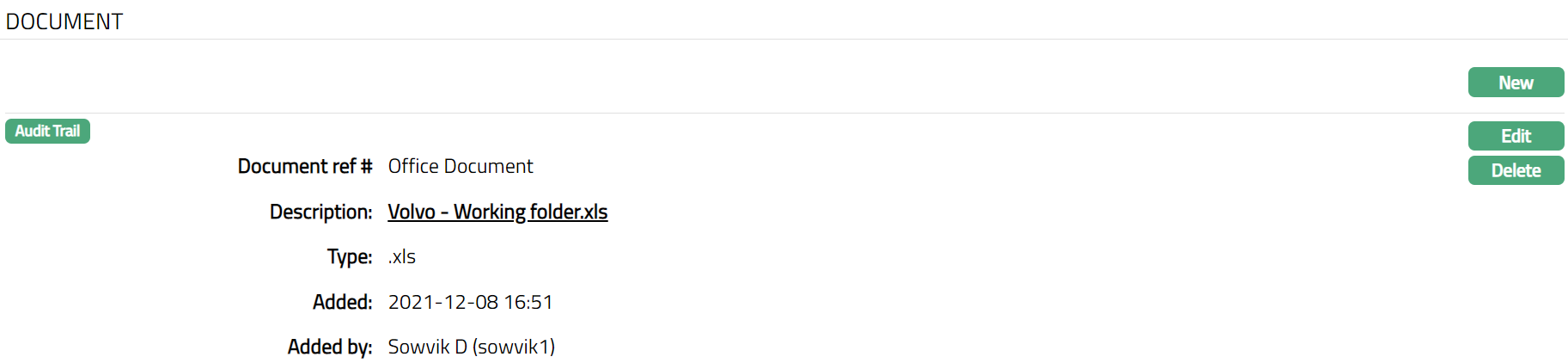
Functions: New, Edit, Delete
Verification
Verification tab allows you to verify the activities of the organisation like whether the organisation is politically exposed and whether the AML check is required for the organisation.
To Add Verification,
1. Access Organisation Due Diligence page.
2. Click Verification tab.

3. Click Add. Add Verification page appears.
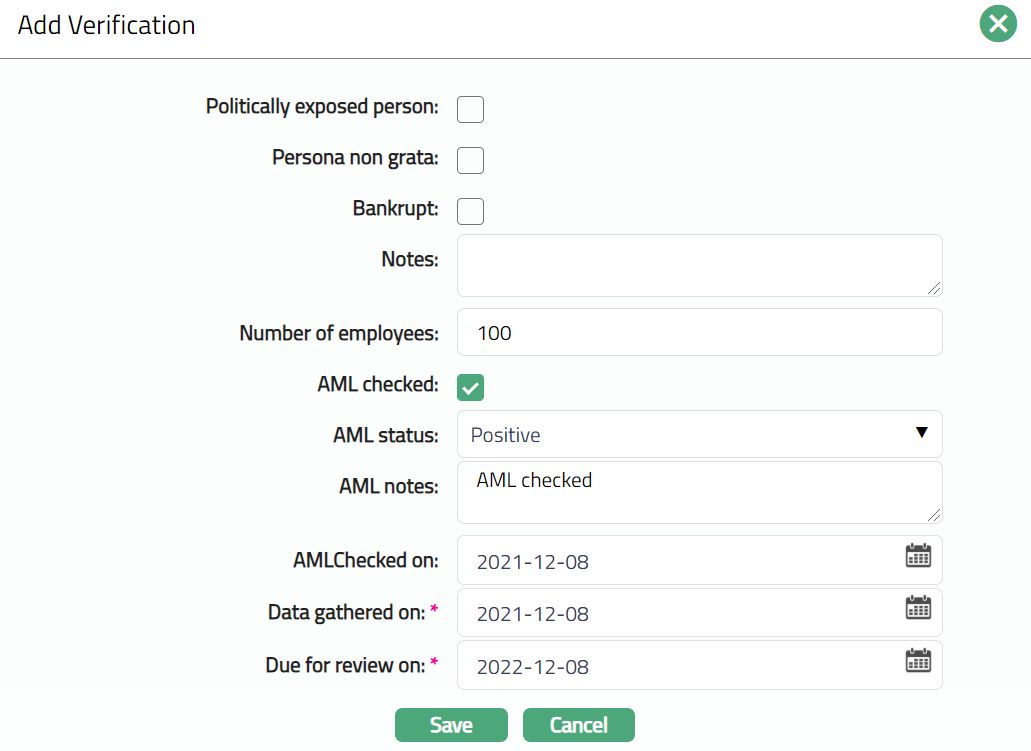
4. Check Politically exposed person check box if the organisation is politically exposed.
5. Check Persona non grata if the organisation has been declared as such.
6. Check Bankrupt check box if the organisation is declared insolvent.
7. Enter Notes, if any, for the Verification.
8. Enter Number of employees in the organisation.
9. Check AML checked check box if the AML check is done for the organisation.
10. Select AML status, whether the AML check is Positive or Negative, from the drop down. This field will be enabled only when the AML checked field is checked for the organisation.
11. Enter AML notes as needed.
12. Enter AML checked on date. This is the date on which the AML check was done.
13. Enter Data gathered on date. This is the date on which you received the Due Diligence data for this Organisation.
14. Enter Due for review on Date. This is the date on which you would like to review the Due diligence data for this Organisation.
15. Click Save. Verification page appears displaying the updated details
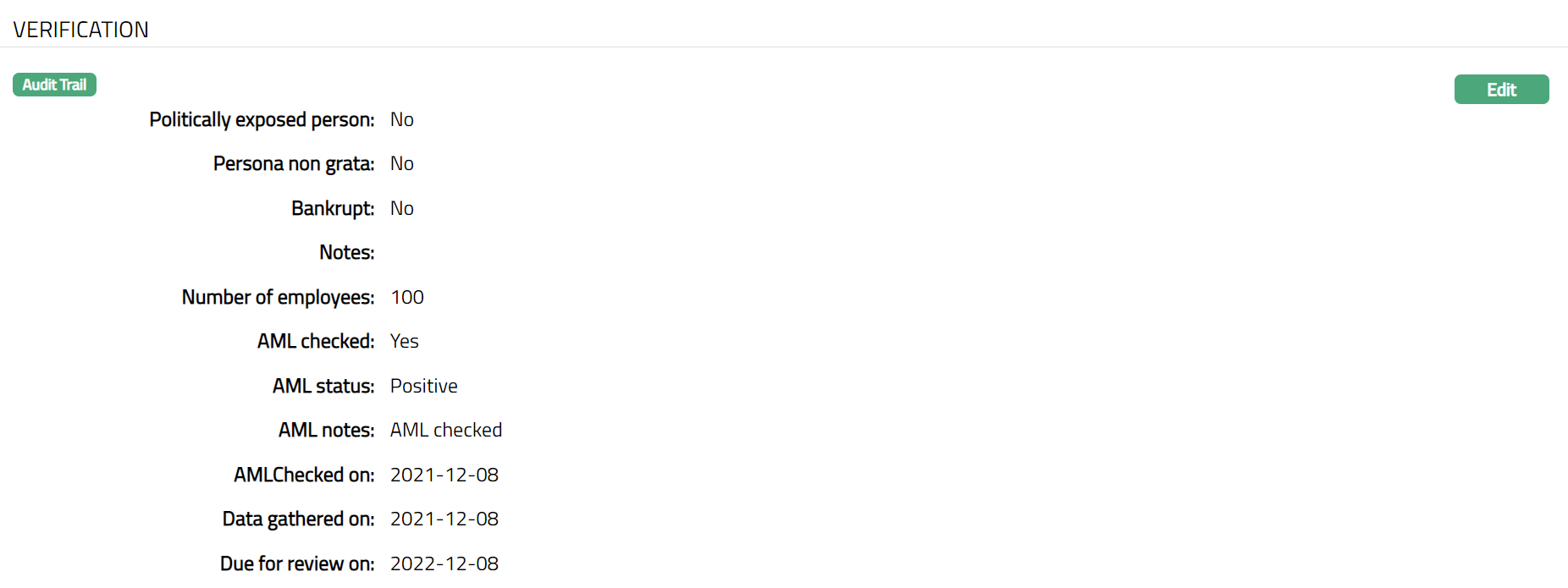
Functions: Edit
To edit Verification record,
1. Access Organisation Due Diligence page and click Verification tab.
2. Click Edit. Edit Verification page appears.
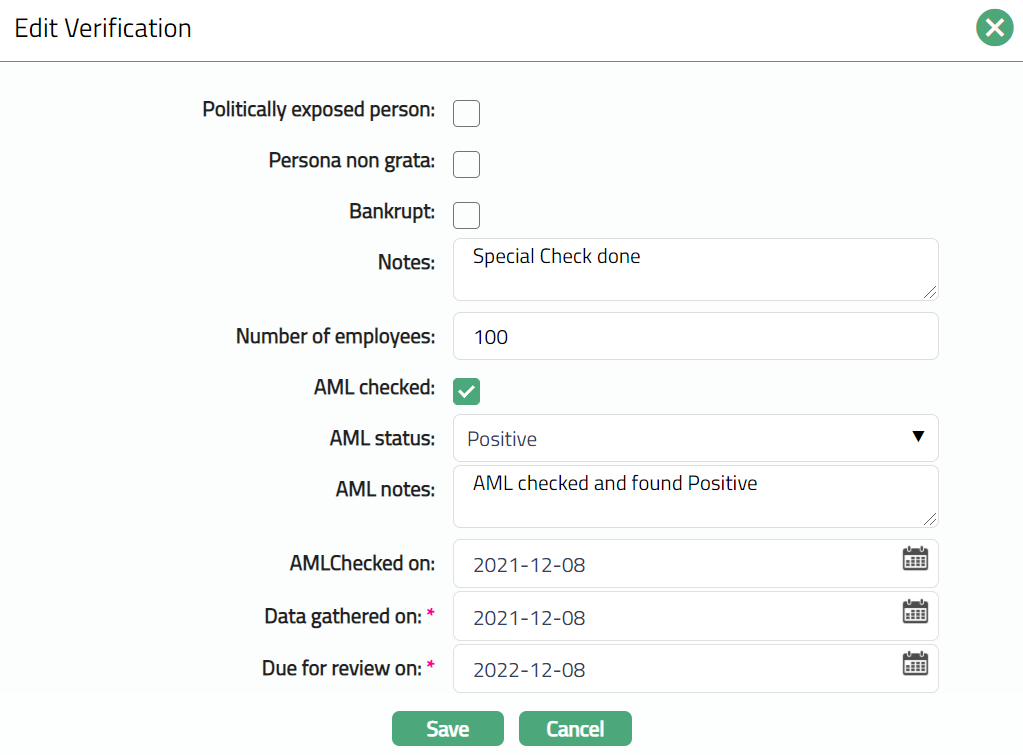
Note: All fields are editable.
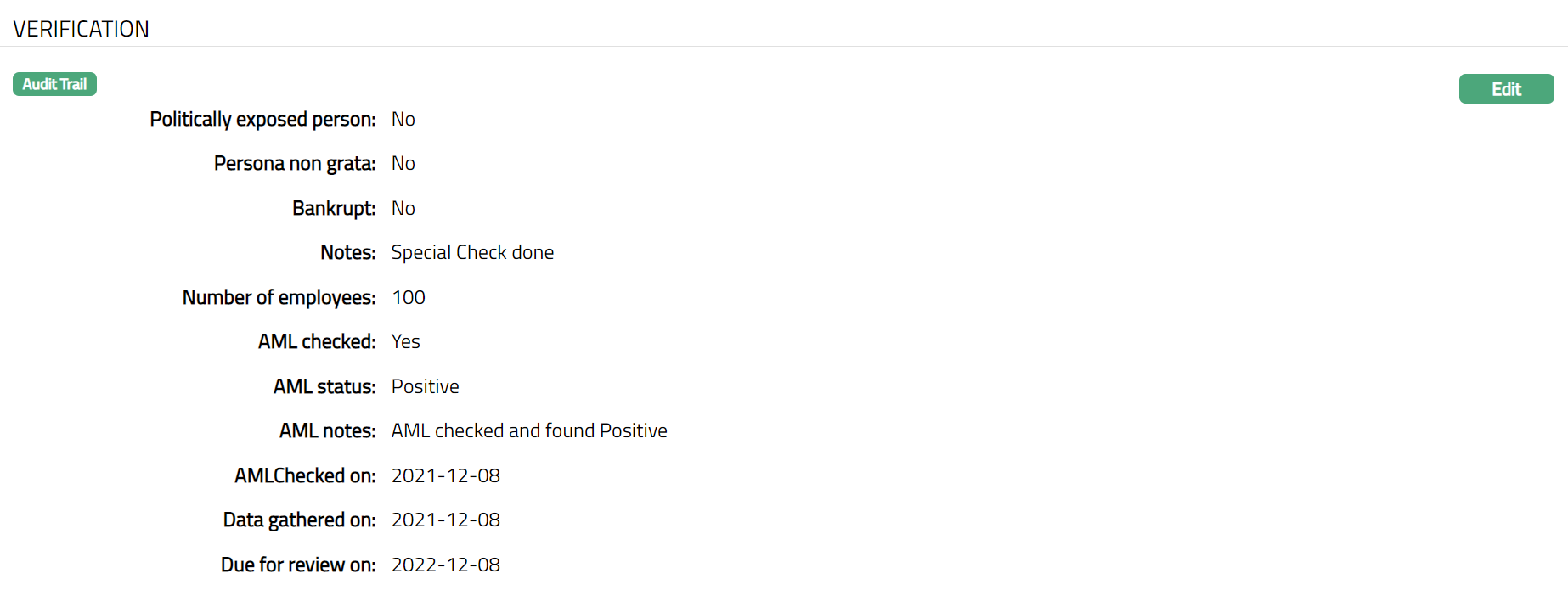
3. Make required changes and click Save. Verification page appears with the edited details.
Status
Status tab shows the due diligence status of the Organisation. By default, the due diligence status of an Organisation is Pending which needs to be Approved.
To add new Status,
1. Access Organisation Due Diligence page.
2. Click Status tab.
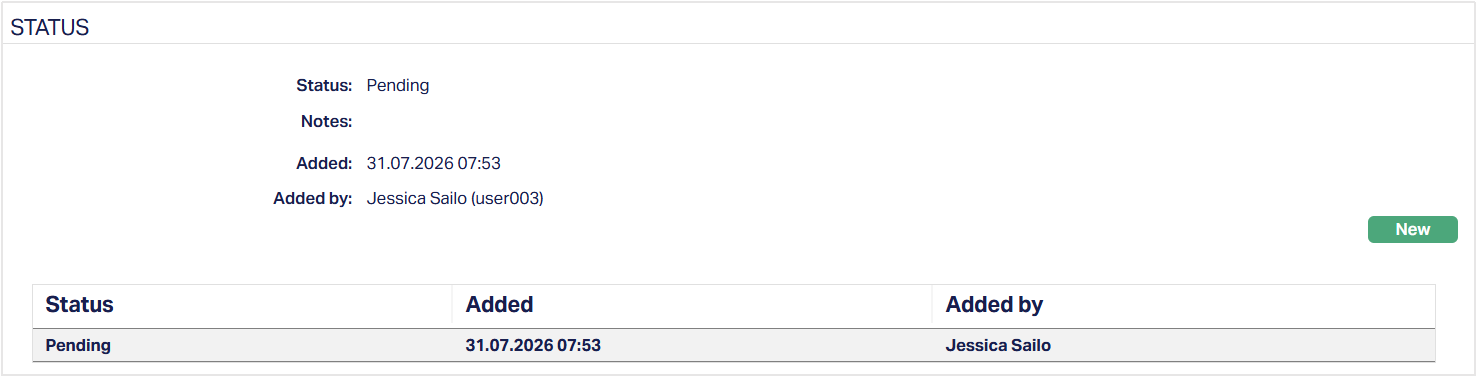
3. Click New. New Status page appears.
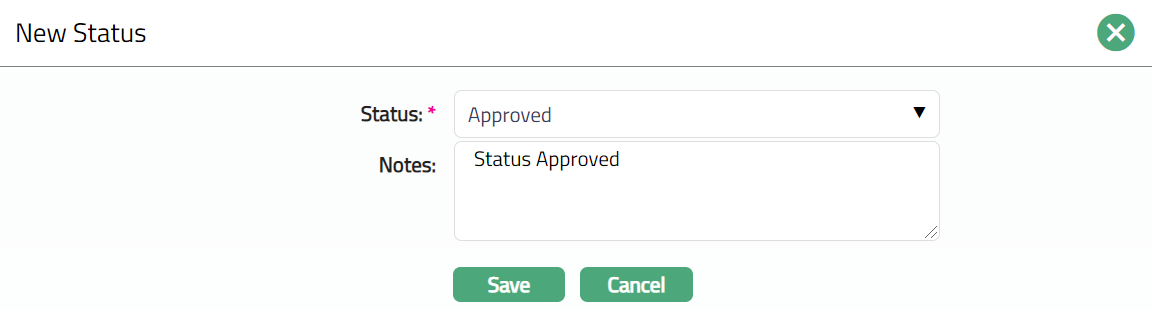
4. Initially Status field will be Pending. If you have completed the due diligence exercise and find it to be satisfactory, you can change the status of due diligence for the Organisation to Approved. To do so, you need to ensure that the Data Gathered On and Data Reviewed On dates are input in Due Diligence → Person → Verification tab
Note: Once the status is approved, if you make any further changes, then the status has to be updated to Changed after Approval. The changes may be approved by updating the status to Approved as described above.
5. Enter Notes if any for the status selected.
6. Click Save. Status page appears with the added details.
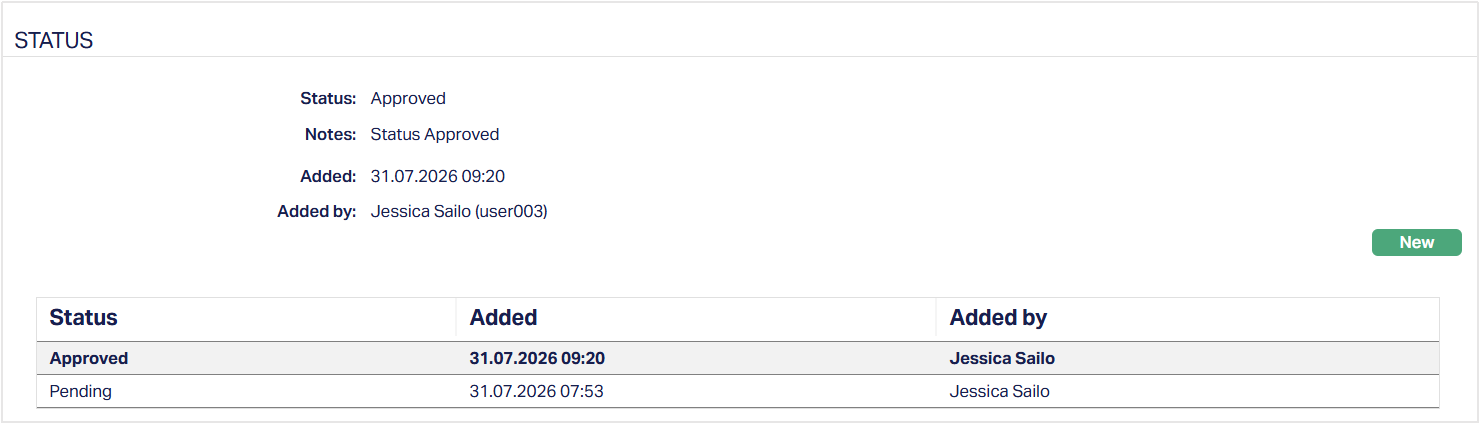
Functions: New
The additional fields are as follows:
Status field denotes the status of the record.
Added field denotes the date on which the record was added.
Added by field denotes the name of the user who created the record.
Custom Field
This option provides you the flexibility to define fields apart from those that are already available in the standard version of Aura. Thus, it enables you to customize additional data storage and use as required to suit your specific business needs.
Using Custom Field tab, you can maintain the custom fields mapped to the Organisation. Depending on the custom fields created and mapped to Organisation (using Admin → System Codes → Custom Fields), the fields will be displayed on this tab.
To edit Custom field,
1. Access Organisation Due Diligence page and click Custom Field tab.

2. Click Edit. Edit Custom Field page appears.

3. Enter details as required and click Save. Custom field page appears with the edited details.

Functions: Edit